
The 2026 FIFA World Cup will be the biggest in history. For the first time ever, 48 nations will compete across 16 venues in the United States, Canada, and Mexico from June 11 to July 19, 2026. The expanded format — up from 32 teams — means more countries, more matches (104 total), and more drama than ever before.
The final six spots were settled on March 31, 2026, in dramatic playoff matches that saw Italy eliminated for a third consecutive World Cup and four nations qualify for the first time ever. Here’s the complete map and breakdown of every qualified nation.
Map: All 48 Qualified Nations
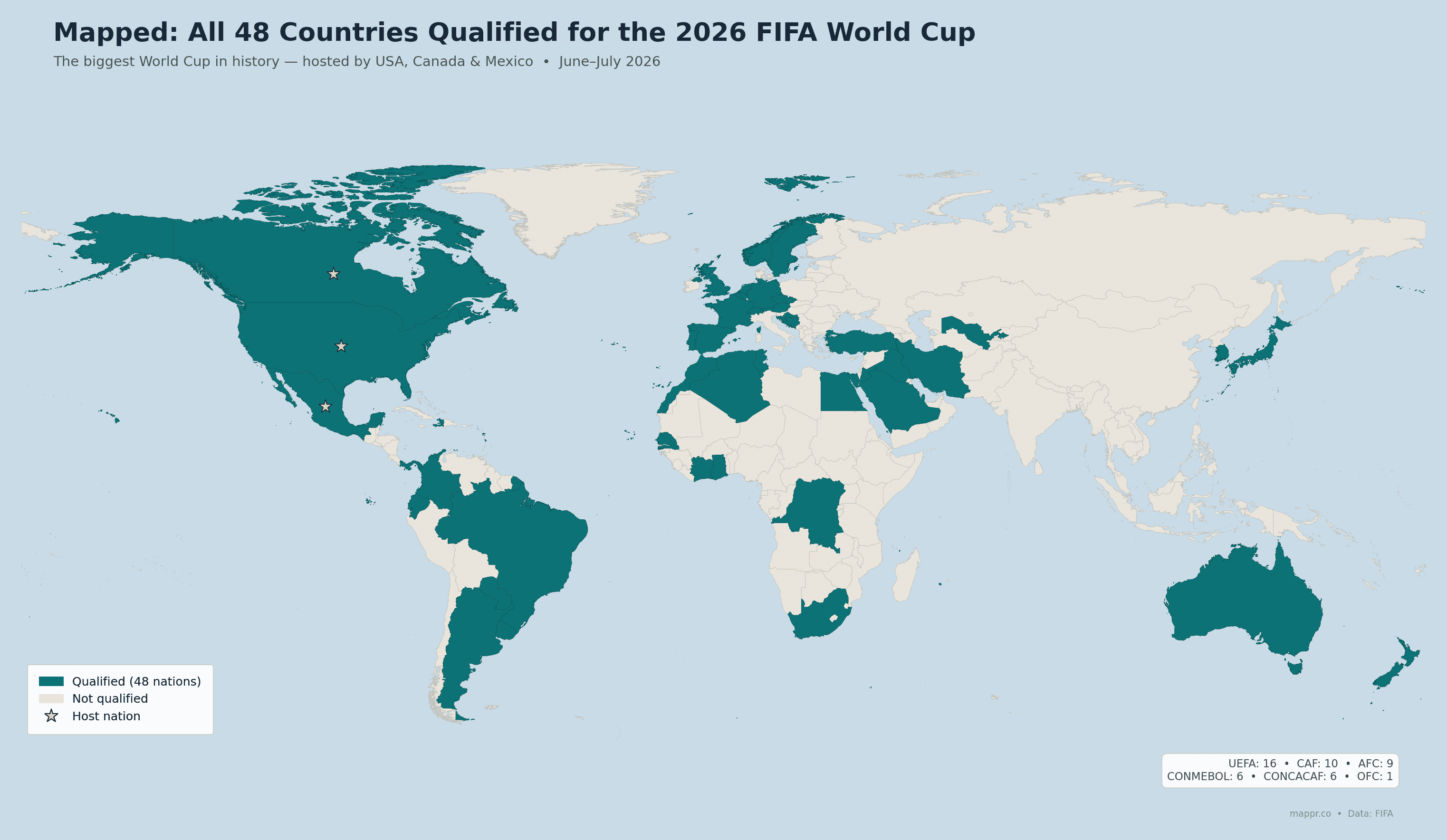
Qualification Breakdown by Confederation
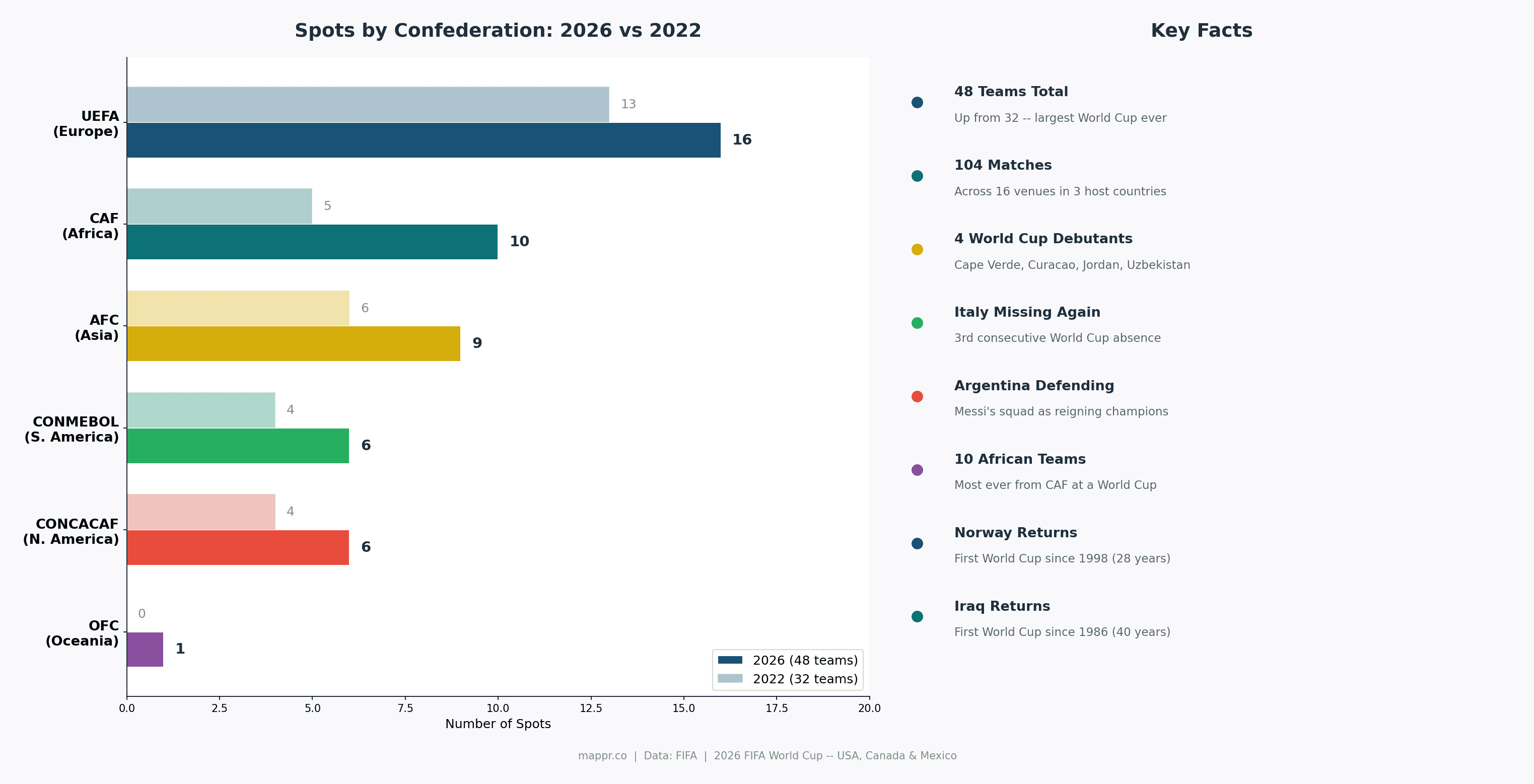
The 48 spots are distributed across FIFA’s six continental confederations. The expanded format dramatically increased representation from Africa, Asia, and the Americas compared to the 32-team era.
UEFA (Europe) — 16 Spots
Europe retains the largest allocation with 16 spots (up from 13 in 2022). The final four spots were decided in dramatic playoffs on March 31.
- Qualified directly: England, France, Germany, Spain, Portugal, Netherlands, Belgium, Croatia, Switzerland, Austria, Norway, Scotland
- Via playoffs: Sweden (beat Poland 3-2), Turkey (beat Kosovo 1-0), Bosnia and Herzegovina (beat Italy on penalties), Czechia (beat Denmark on penalties)
CAF (Africa) — 10 Spots
Africa sees its largest-ever World Cup contingent with 10 teams — double the five spots allocated in 2022. This includes first-time qualifier Cape Verde.
- Qualified directly: Algeria, Cape Verde, Egypt, Ghana, Ivory Coast, Morocco, Senegal, South Africa, Tunisia
- Via intercontinental playoff: DR Congo (beat Jamaica 1-0)
AFC (Asia) — 9 Spots
Asia’s allocation jumped from 6 to 8.5 spots (rounded to 9 with the intercontinental playoff). Japan was the first team in the world to qualify. First-time qualifiers Jordan and Uzbekistan headline the Asian contingent.
- Qualified directly: Australia, Iran, Japan, Jordan, Qatar, Saudi Arabia, South Korea, Uzbekistan
- Via intercontinental playoff: Iraq (beat Bolivia 2-1)
CONMEBOL (South America) — 6 Spots
South America sends six teams, up from four direct spots plus a playoff in 2022. Defending champions Argentina lead the pack alongside perennial powerhouses Brazil and Uruguay.
- Qualified: Argentina, Brazil, Colombia, Ecuador, Paraguay, Uruguay
CONCACAF (North/Central America & Caribbean) — 6 Spots
CONCACAF benefits enormously from hosting the tournament, with three automatic spots for USA, Canada, and Mexico. The remaining three spots were earned in qualifying, including history-making Curaçao — the smallest nation by population ever to qualify for a World Cup.
- Host nations (automatic): United States, Canada, Mexico
- Qualified: Curaçao, Haiti, Panama
OFC (Oceania) — 1 Spot
Oceania gets a guaranteed spot for the first time in World Cup history. Previously, the OFC champion had to win an intercontinental playoff. New Zealand claimed the berth.
- Qualified: New Zealand
First-Time Qualifiers
The expanded 48-team format opened the door for four nations making their World Cup debut:
- Curaçao — Population ~170,000. The smallest nation ever to qualify for a World Cup. The Caribbean island, a constituent country of the Kingdom of the Netherlands, beat Jamaica in a winner-takes-all qualifier. Many of their players accessed European football through Dutch youth academies.
- Cape Verde — Population ~596,000. The volcanic archipelago off Africa’s west coast won their qualifying group ahead of Cameroon. Another island nation punching far above its weight.
- Jordan — Population ~10.2 million. After years of near-misses, Jordan finally broke through in Asian qualifying. They also reached the 2024 Asian Cup final, signaling a genuine rise in Middle Eastern football.
- Uzbekistan — Population ~34.2 million. Under Italian World Cup-winning captain Fabio Cannavaro as manager, Uzbekistan qualified with six wins, three draws, and just one defeat. Manchester City’s Abdukodir Khusanov leads their squad.
Notable Absences
Even with 48 spots, some major footballing nations missed out:
- Italy (FIFA #12) — The four-time World Cup winners have now failed to qualify for three consecutive World Cups (2018, 2022, 2026). They lost to Bosnia and Herzegovina on penalties in the playoff final, with Alessandro Bastoni’s red card proving decisive. It’s an unprecedented crisis for Italian football.
- Denmark (FIFA #21) — The 2022 Euro semi-finalists were eliminated by Czechia on penalties in the UEFA playoffs.
- Poland (FIFA #35) — Robert Lewandowski’s side fell to Sweden 3-2 in the playoff final.
- Nigeria (FIFA #26) — Africa’s most prominent absentee, missing their second straight World Cup despite a golden generation of talent including Victor Osimhen and Ademola Lookman.
- Russia (FIFA #36) — Still banned from FIFA and UEFA competitions due to the invasion of Ukraine.
- Wales, Cameroon, Serbia — All recent World Cup participants who failed to qualify this cycle.
Notable Returning Nations
- Norway — First World Cup since 1998 (28-year gap). Erling Haaland scored 16 goals in qualifying, making them one of the tournament’s dark horses.
- Iraq — First World Cup since 1986 (40-year gap). Won the intercontinental playoff against Bolivia 2-1.
- Scotland — Returns after missing the 2022 tournament. Drawn in a tough Group A alongside Mexico and South Korea.
- Haiti — Only their second World Cup appearance ever (first since 1974).
The 12 Groups
The 48 teams are drawn into 12 groups of four. The top two from each group plus the eight best third-placed teams advance to a Round of 32 knockout stage.
- Group A: Mexico, South Korea, South Africa, Czechia
- Group B: Canada, Switzerland, Qatar, Bosnia & Herzegovina
- Group C: Brazil, Morocco, Scotland, Haiti
- Group D: USA, Australia, Paraguay, Turkey
- Group E: Germany, Ecuador, Ivory Coast, Curaçao
- Group F: Netherlands, Japan, Tunisia, Sweden
- Group G: Belgium, Egypt, Iran, New Zealand
- Group H: Spain, Cape Verde, Saudi Arabia, Uruguay
- Group I: France, Senegal, Iraq, Norway
- Group J: Argentina, Algeria, Austria, Jordan
- Group K: Portugal, Colombia, Uzbekistan, DR Congo
- Group L: England, Croatia, Panama, Ghana
Key Numbers
- 48 — Total qualified teams (up from 32)
- 104 — Total matches to be played
- 16 — Host venues across 3 countries
- 4 — Nations making their World Cup debut
- 10 — African teams, the most ever at a World Cup
- 3 — Consecutive World Cups missed by Italy
- 40 — Years since Iraq’s last World Cup appearance
- ~170,000 — Population of Curaçao, smallest qualifier ever
- 6+ million — Expected total attendance
What’s Next
The 2026 FIFA World Cup kicks off on June 11, 2026, with co-host Mexico facing South Africa in Mexico City — a rematch of the 2010 World Cup opener. The tournament final will be held at MetLife Stadium in New Jersey on July 19, 2026. Argentina, led by Lionel Messi, will look to defend the trophy they lifted in Qatar in 2022.
With four debutants, the biggest-ever African contingent, and powerhouses like France, Brazil, and Spain all in the mix, this expanded World Cup promises to be the most global and competitive edition of the tournament yet.

This article draws on official FIFA qualification data and trusted sports journalism sources.
Official Sources:
- FIFA — 2026 FIFA World Cup Official Page – Official tournament page with qualified teams and group draw
News Coverage:
- USA Today — World Cup qualifying results – Full 48-team field after playoffs
- Yahoo Sports — 2026 FIFA World Cup schedule and groups – Qualified teams, groups, match schedule
- Al Jazeera — Which teams are in the FIFA World Cup 2026? – Comprehensive qualification tracker
- ESPN — Meet 2026 World Cup debutants – First-time qualifiers profile