Key Takeaways
- Cyclone Murasu made landfall near Ongole early on 3 November. The severe cyclonic storm crossed the south Andhra Pradesh coast between Nellore and Narsapur, close to Ongole in Prakasam district, between about 3:30 and 5:30 a.m. local time.
- Winds of 100 to 110 km/h, gusting to 120. The India Meteorological Department recorded sustained winds of 100 to 110 km/h with gusts to 120, heavy rain, and a storm surge of about 1 to 1.5 metres above the tide.
- Thousands evacuated, no major casualties reported early. Authorities evacuated thousands from low-lying areas, cancelled flights and suspended transport. Early reports described downed trees and poles, damaged thatched homes and boats, and crop losses, but no major deaths or injuries.
- It is already weakening inland. Murasu is forecast to track north-northwest and weaken into a depression as it moves away from the coast, with heavy rain continuing across interior Andhra Pradesh, Telangana and parts of Odisha.
Developing story. Figures are provisional and may change; this reflects reporting as of the morning of 3 November 2026 (IST).
For the second time in a week, a cyclone has come ashore on India’s Andhra Pradesh coast. Severe Cyclonic Storm Murasu crossed the south Andhra coast near Ongole, in Prakasam district, in the early hours of 3 November 2026, days after Cyclone Arnab struck further north near Kakinada.
Murasu made landfall between Nellore and Narsapur, close to Ongole, between roughly 3:30 and 5:30 a.m. IST, as a severe cyclonic storm with sustained winds of 100 to 110 km/h gusting to 120. Heavy rain, gale-force winds and a storm surge of 1 to 1.5 metres hit coastal Prakasam, Bapatla and Krishna districts.
The Track: From the Bay of Bengal to Ongole
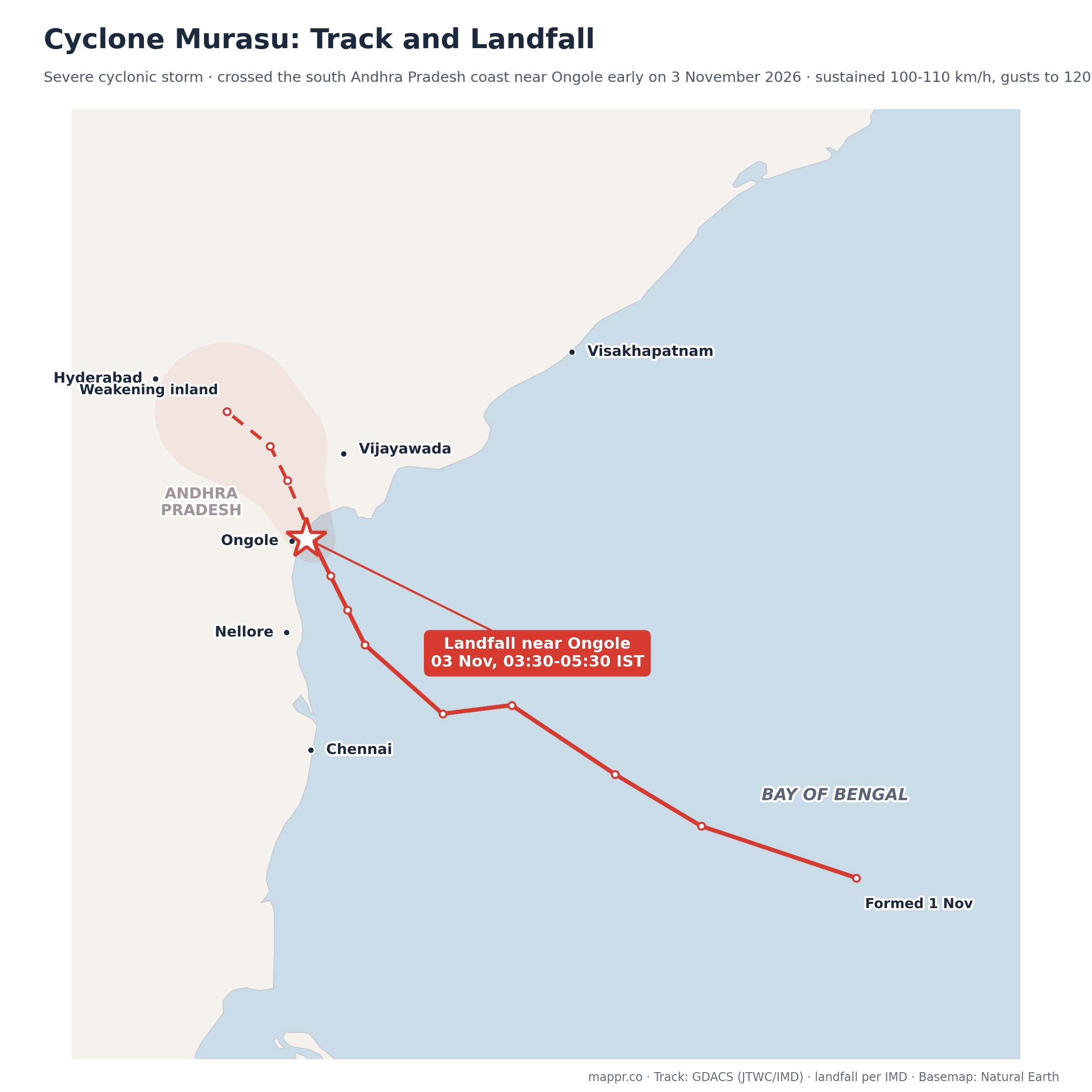
Murasu formed in the central Bay of Bengal on 1 November and tracked west-northwest toward the coast, strengthening into a severe cyclonic storm before crossing land near Ongole. After landfall it is expected to curve north-northwest and weaken, dropping heavy rain across interior Andhra Pradesh and into Telangana as it decays.
What We Know So Far
🌊 The landfall
The IMD confirmed the landfall process began around 3:30 a.m. and completed by about 5:30 a.m. IST near Ongole, close to latitude 15.5°N and longitude 80.2°E. Outer rain bands had been lashing the coast for hours before the centre crossed.
🏚️ The damage
Early reports from Andhra Pradesh describe thousands of uprooted trees, downed power poles, damaged thatched homes and boats, and standing-crop losses across the coastal districts. Rough seas battered the shoreline near Ongole. Transport was disrupted and flights cancelled, but as of the first updates no major deaths or injuries had been widely reported, a sign the evacuations did their job.
🚨 The response
Authorities issued red alerts for several districts, evacuated thousands from low-lying and coastal areas, and pre-positioned disaster-response teams. Neighbouring Odisha and Tamil Nadu also saw rain and wind on the system’s margins.
A Second Cyclone in a Week
Murasu follows Cyclone Arnab, which struck the Andhra coast near Kakinada on 28 October and killed at least seven people. Two severe cyclonic storms making landfall on the same stretch of coast within a week is an unusually active late-season run for the Bay of Bengal, where the post-monsoon months of October and November are the peak cyclone window.
We will update this post as damage assessments, any casualty figures, and the storm’s inland track become clearer through the day.