
Key Takeaways
- More than 1 billion people live with a mental disorder. That is roughly 1 in 8 of humanity, per the WHO. Anxiety disorders are the most common (470 million people in 2023), with depression close behind (322 million).
- Depression and anxiety have different maps. Depression burden peaks in conflict-hit and Central African countries (Syria 8.0%, Congo, CAR, Angola) plus the UK and Netherlands. Anxiety peaks in Malta (13.8%), Portugal (13.7%), Brazil, Iran and the Anglosphere.
- The burden is growing fast. Between 2019 and 2023, the global age-standardized disease-burden rate rose about 20% for depression and nearly 45% for anxiety. Together they cost 110 million years of healthy life in 2023.
- Care is concentrated where the burden is lowest. Norway has 48 psychiatrists per 100,000 people; Chad has 0.007. Only about 1 in 4 people who need treatment for anxiety disorders receive any.
Friday, October 10, is World Mental Health Day, and this year’s theme (“Lived experiences heard: real voices, real change”) lands on top of a sobering statistical update. The WHO’s latest estimates count more than 1 billion people, about 1 in 8 of humanity, living with a mental disorder.
The two giants are anxiety disorders (470 million people in 2023) and depressive disorders (322 million). And they are growing: in the WHO’s new Global Health Estimates released on October 2, the age-standardized burden rate rose roughly 20% for depression and nearly 45% for anxiety between 2019 and 2023, together erasing an estimated 110 million years of healthy life in a single year.
So we mapped both conditions, country by country, and then mapped the thing that should mirror them but doesn’t: where the world’s mental-health care actually is.
Depression Around the World
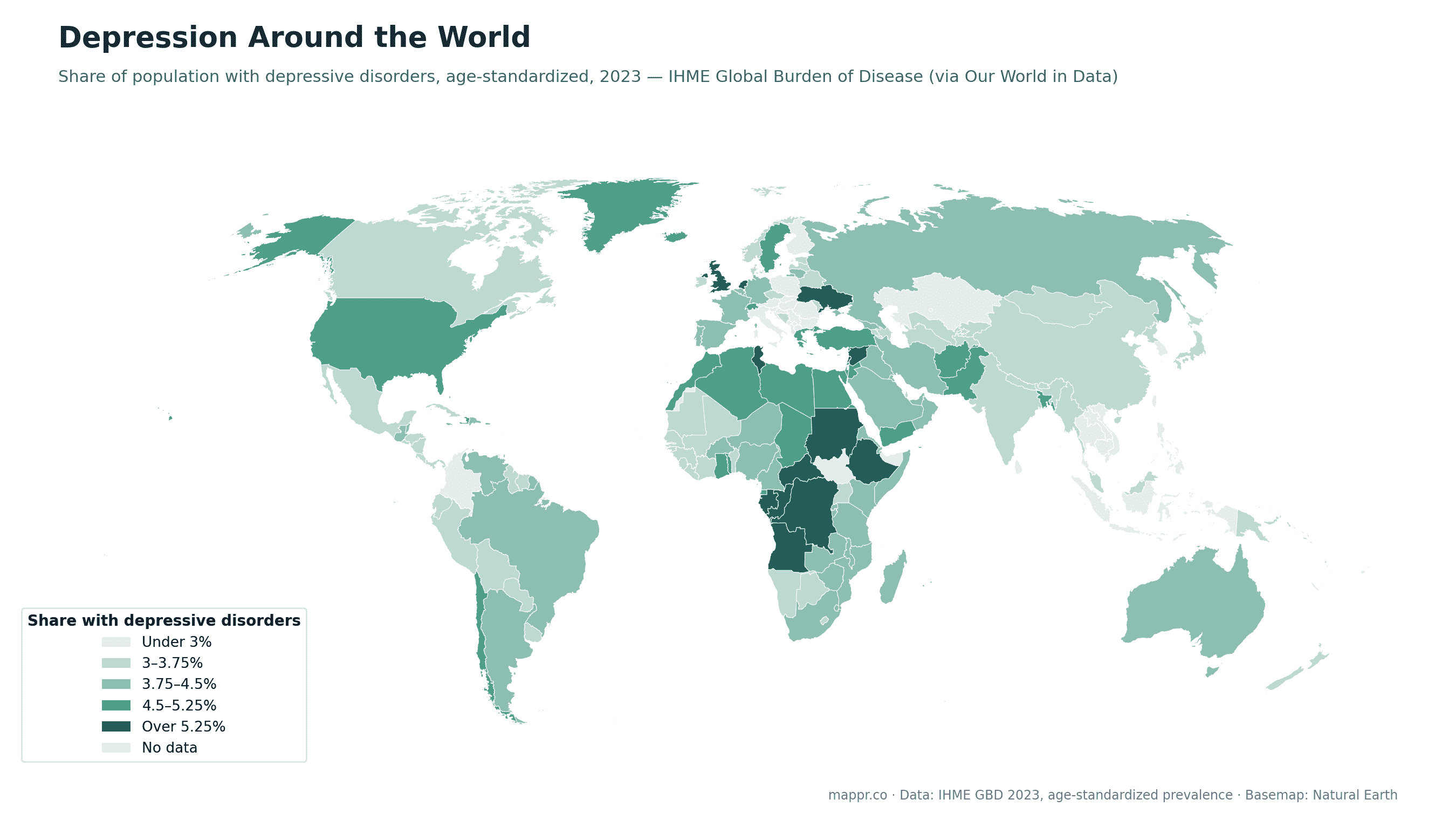
The global median is about 3.7% of the population, but the spread is wide.
The heaviest burden sits in two very different places. The first is countries shaped by war and displacement: Syria tops the world at 8.0%, with Ukraine (5.3%) and Lebanon (5.6%) also far above the median. The second is a belt of Central African countries: Congo, DR Congo, the Central African Republic and Angola all sit between 5.8% and 5.9%, joined by Sudan and Ethiopia just behind.
Two high-income outliers stand out: the United Kingdom (6.8%) and the Netherlands (6.2%) rank above every other wealthy country, a mix of genuinely high distress and the fact that rich countries measure depression far more thoroughly. The United States sits at 4.6%, Germany at 4.4%.
At the other end, Singapore records the world’s lowest rate (1.7%), with Romania, Thailand, Croatia and Indonesia all under 2.4%.
Anxiety Has a Different Map
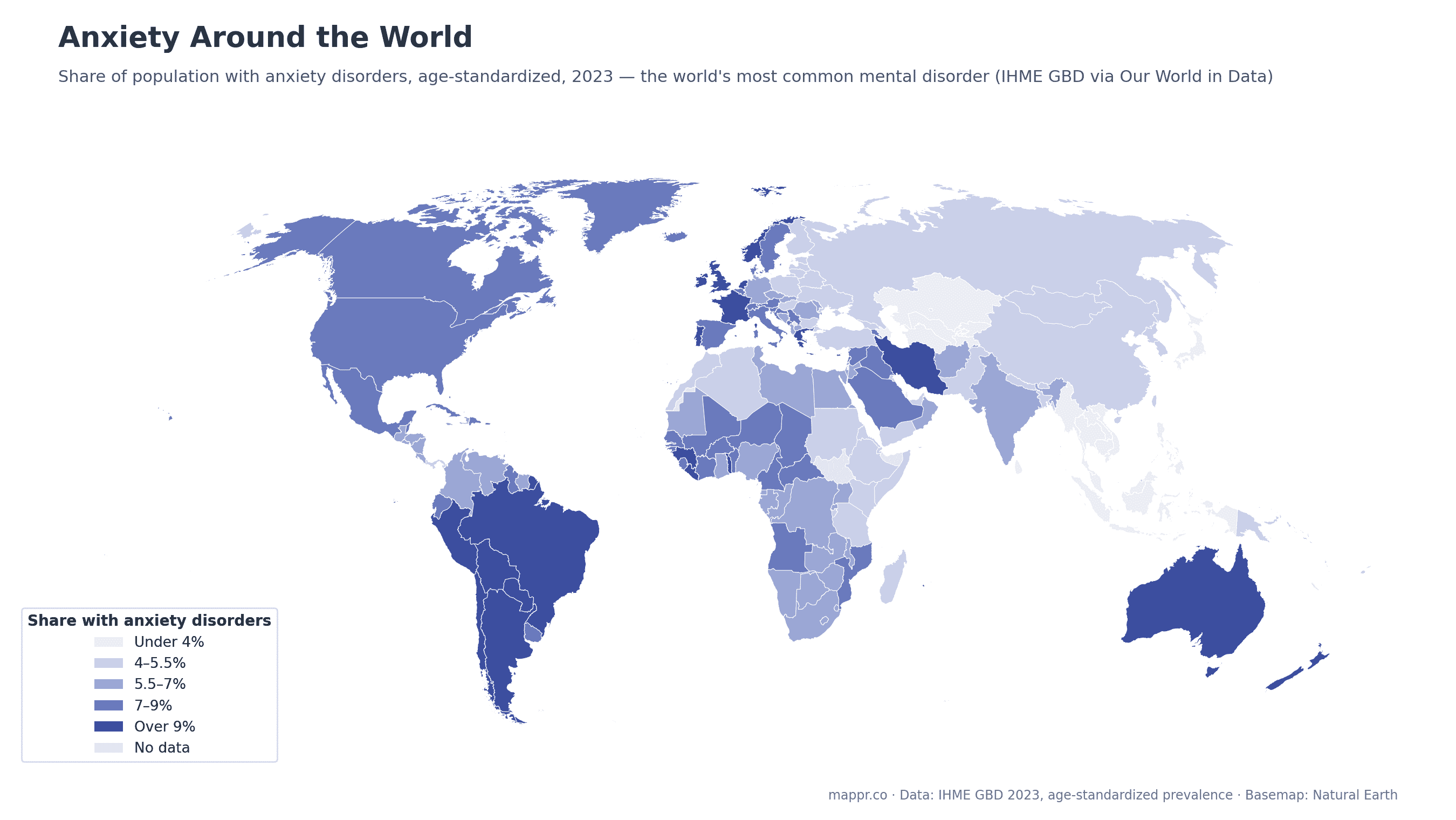
Anxiety is the world’s most common mental disorder, and its geography is strikingly different. The hotspots are not conflict zones but Southern Europe, the Americas and the Anglosphere: Malta leads the world at 13.8%, followed by Portugal (13.7%), the Netherlands (12.4%), Iran (12.0%), Brazil (11.6%), Cyprus, Australia and the UK (all above 11%).
Latin America lights up almost uniformly, and so do France, Spain and Greece. Meanwhile much of East and Southeast Asia reports the world’s lowest rates: Mauritius, Vietnam, Sri Lanka, Malaysia and Thailand all sit near 2%.
Part of this split is real, driven by culture, urban stress and demographics. Part of it is measurement: anxiety disorders are diagnosed and surveyed far more aggressively in rich, Western health systems, while stigma and sparse screening suppress reported rates elsewhere. The modelers behind the Global Burden of Disease adjust for this where they can, but the caveat belongs on the map.
The Highest-Burden Countries
Ranked
Where depression burden is highest
Top 12 countries by age-standardized depressive-disorder prevalence (2023), with anxiety prevalence and psychiatrist density for comparison.
| Country | Depression | Anxiety | Psychiatrists /100k |
|---|---|---|---|
| 🇸🇾 Syria | 8.0% | 7.2% | 0.4 |
| 🇬🇧 United Kingdom | 6.8% | 11.3% | n/a |
| 🇳🇱 Netherlands | 6.2% | 12.4% | 20.9 |
| 🇨🇬 Congo | 5.9% | 6.8% | 0.08 |
| 🇨🇩 DR Congo | 5.9% | 5.9% | n/a |
| 🇨🇫 Central African Republic | 5.8% | 8.5% | 0.02 |
| 🇦🇴 Angola | 5.8% | 7.9% | 0.06 |
| 🇹🇳 Tunisia | 5.7% | 7.0% | n/a |
| 🇬🇦 Gabon | 5.7% | 7.0% | 0.26 |
| 🇱🇧 Lebanon | 5.6% | 7.9% | 1.2 |
| 🇺🇦 Ukraine | 5.3% | 4.7% | 6.9 |
| 🇪🇹 Ethiopia | 5.3% | 4.8% | 0.08 |
The Care Inversion
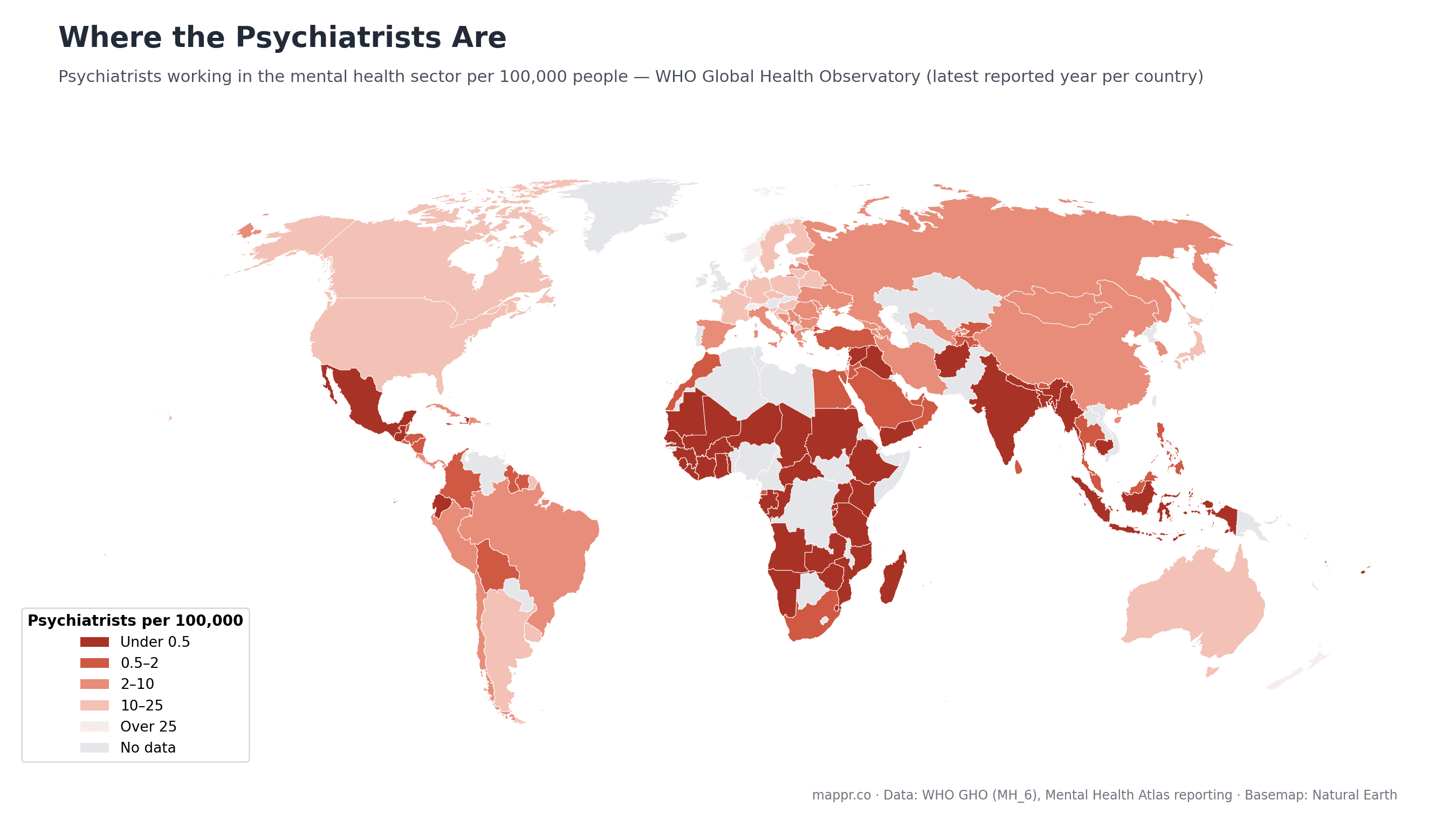
Now flip the question: where are the people trained to treat any of this?
Norway has 48 psychiatrists per 100,000 people. Switzerland has 44. Chad has 0.007, which is roughly one psychiatrist for every 14 million people. Burundi, Niger, Mali and most of the Sahel sit below 0.03.
Hold the two maps side by side and the inversion is brutal. The Central African Republic carries one of the world’s heaviest depression burdens (5.8%) with 0.02 psychiatrists per 100,000 people. The Netherlands, with a comparable prevalence, has roughly a thousand times the specialist density.
The WHO estimates that only about 1 in 4 people who need treatment for anxiety disorders receive any, and treatment coverage for depression in low-income countries is thinner still. In high-income countries, roughly one third of people with depression receive formal care; in much of Sub-Saharan Africa the share is in the single digits.
The economics are not subtle either: the WHO and partners have long estimated that depression and anxiety cost the global economy around US$1 trillion a year in lost productivity, an estimate first published in 2016 that predates the post-pandemic rise.
What These Maps Can and Cannot Say
Prevalence maps measure estimated disorders, not suffering, and they inherit every bias of the underlying data. Rich countries screen more, survey more and diagnose more; fragile states barely count at all, so the modeled estimates there carry wide uncertainty. A dark country on the anxiety map is not simply “more anxious” than a pale one.
What the maps can say is this: the burden is enormous everywhere, it is rising fastest in exactly the anxiety belt the pandemic hit, and the places with the heaviest depression burdens are, almost without exception, the places with the least capacity to treat them. That gap, not the prevalence itself, is the finding.
If you are struggling, help exists and works: effective treatment is available for mild, moderate and severe depression and anxiety alike. In a crisis, contact your local emergency services or a suicide prevention line such as the international helpline directory.
Data and reporting for this article come from the following sources: