Key Takeaways
- 14.6% of Schengen visa applications were refused in 2025. The European Commission's 2025 figures show more than 12 million short-stay visa applications, of which about 1.75 million were rejected, a global refusal rate of 14.6%.
- Same passport, very different odds. Your nationality is the biggest predictor of rejection. A Chinese applicant faces a 4% refusal rate; a Senegalese applicant, 51.9%. That is roughly a 13-fold difference for the same visa.
- African and South Asian applicants are refused most. Bangladesh (54.5%), Burundi (53.4%), Senegal (51.9%), Nigeria (47.9%) and Pakistan (45.9%) top the list. African applicants are rejected at roughly two to three times the global rate.
- A €157 million rejection tax. Because the €90 application fee is non-refundable, rejected applicants lost about €157 million in 2025. African countries paid 42% of that despite making just 24% of applications, a pattern critics call 'reverse remittances'.
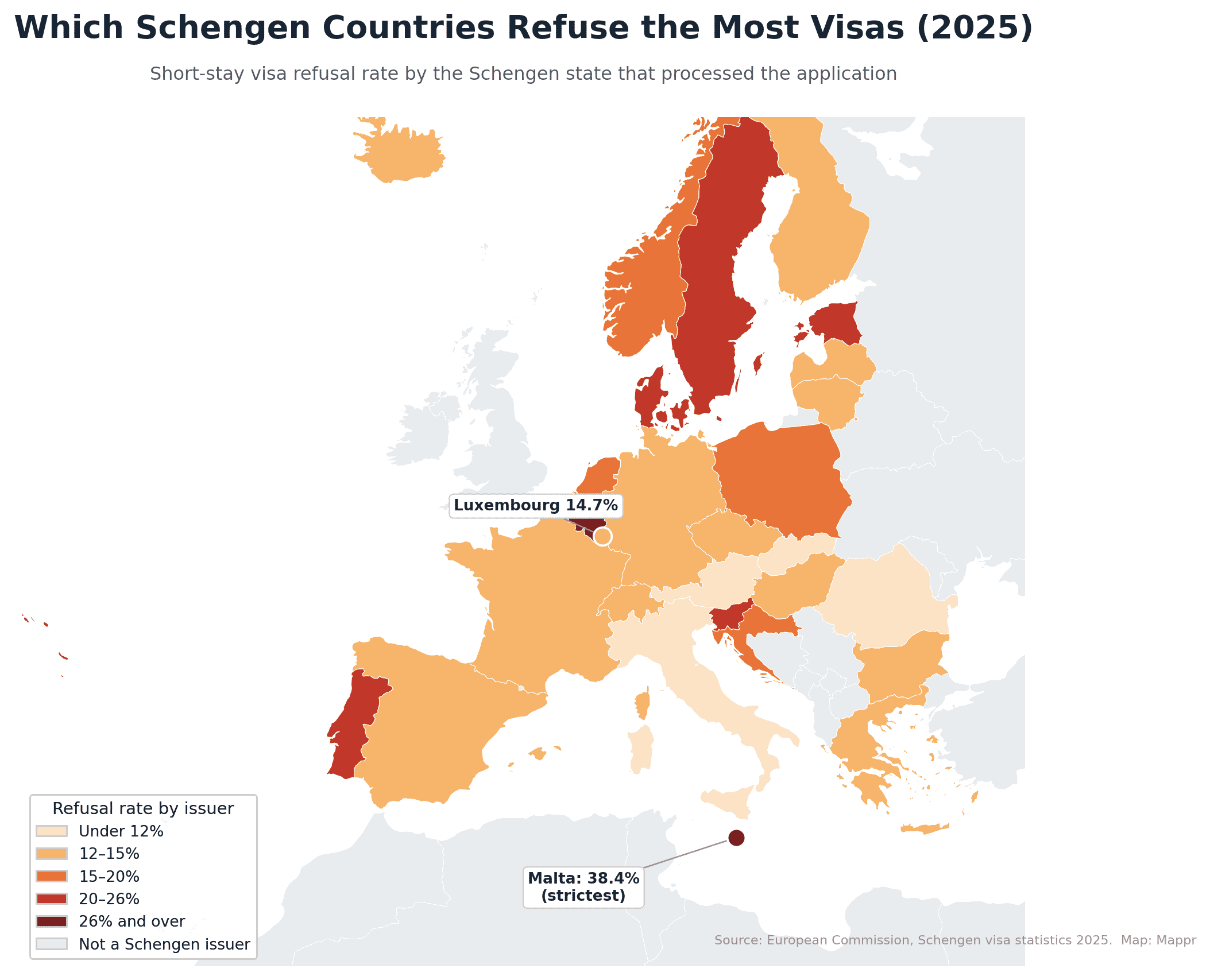
- Where you apply matters too. Malta refused 38.4% of applications, the strictest of any Schengen state, while Slovakia refused just 9.6%. The same person can face very different odds depending on which country's consulate handles the file.
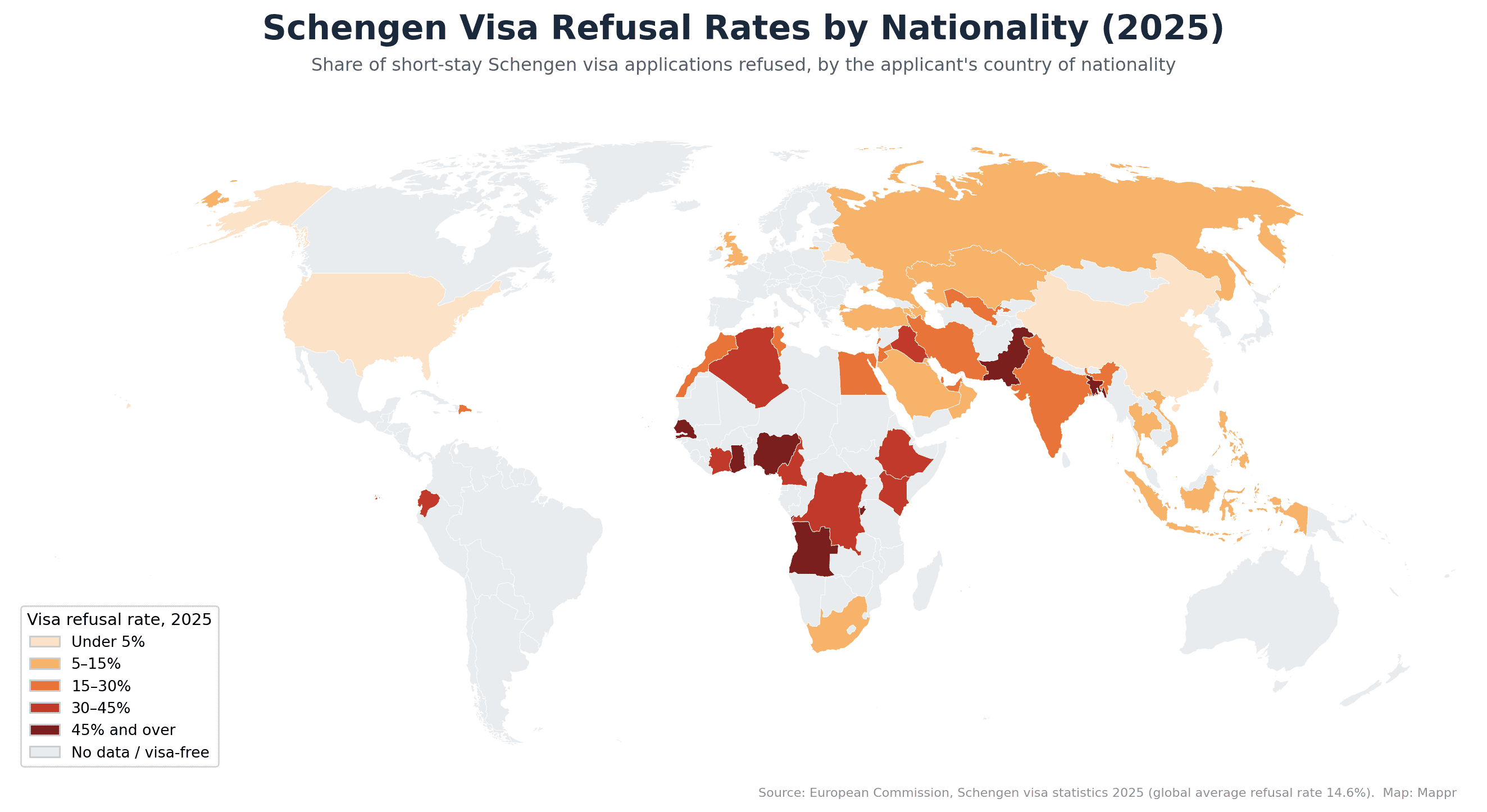
A Schengen visa opens 29 European countries to short-stay visitors, but the odds of getting one depend enormously on the passport you hold. The European Commission’s newly released 2025 statistics show a global refusal rate of 14.6%, yet that single number hides a vast gulf: some nationalities are turned down more than half the time, while others are refused barely one application in twenty. The map below shows the refusal rate for each applicant nationality.
It is one of the clearest maps of global inequality you will see. The darkest countries, where more than 45% of applicants are rejected, are concentrated in West and Central Africa and South Asia. The lightest, where refusal is rare, include China, the United States and much of the wealthier world.
The global picture
In 2025, people filed more than 12 million short-stay Schengen visa applications, up 4.3% on the previous year, and about 10.3 million were approved. The remaining 1.75 million or so were refused, at an overall rate of 14.6%, slightly down from 14.8% in 2024. The biggest sources of applications were China (1.9 million), Turkey (1.3 million), India (1.2 million), Russia and Morocco.
Same passport, very different odds
The headline story is how unevenly refusals fall. The highest rejection rates in 2025 belonged to Bangladesh (54.5%), Burundi (53.4%), Senegal (51.9%), Nigeria (47.9%), Ghana (46.5%), Pakistan (45.9%) and Angola (45.4%). For applicants from these countries, being refused is more likely than being approved.
At the other end, refusal is the exception. China (4.0%), the United States (4.9%), Saudi Arabia and Indonesia (both 5.2%), South Africa (5.3%) and Russia (6.4%) all sit in the low single digits. Put starkly, a Chinese applicant is roughly 13 times less likely to be refused than a Senegalese one, for exactly the same visa. Refusal rates are also rising fastest in some of the poorest countries: Burundi jumped from 40% to 53.4% in a single year, and DR Congo from 29.9% to 40.1%.
2025
The nationalities most likely to be refused a Schengen visa
Short-stay Schengen visa refusal rate, applications and visas issued, for the highest-refusal nationalities in 2025.
| Country | Refused | Applications | Issued |
|---|---|---|---|
| Bangladesh | 54.5% | n/a | n/a |
| Burundi | 53.4% | n/a | n/a |
| Senegal | 51.9% | 71,923 | 34,233 |
| Nigeria | 47.9% | 113,359 | 57,061 |
| Ghana | 46.5% | 63,725 | 33,656 |
| Pakistan | 45.9% | 89,270 | 45,970 |
| Angola | 45.4% | 72,766 | 39,362 |
| Cameroon | 40.3% | 57,469 | 33,902 |
| DR Congo | 40.1% | 52,048 | 30,272 |
| Iraq | 34.3% | 70,312 | 45,113 |
| Ethiopia | 34.0% | n/a | n/a |
| Kenya | 33.1% | 77,760 | 50,517 |
It also depends on where you apply
Nationality is not the only variable. The 29 Schengen states apply the common rules differently, so the same person can face very different odds depending on which country’s consulate handles the file. Malta was by far the strictest in 2025, refusing 38.4% of all applications, followed by Belgium (26.1%), Estonia (24.6%), Portugal (23.4%) and Sweden (23.3%). The most lenient were Slovakia (9.6%), Italy (10.8%), Romania (11.5%) and Austria (11.9%). France, which processes by far the most applications (3.1 million), sat close to the average at 14.2%.
A €157 million rejection tax
Every application costs €90 per adult, and that fee is not refunded when a visa is refused. Because the highest refusal rates fall on the poorest countries, the burden is deeply unequal. The LAGO Collective calculates that rejected applicants lost about €157 million in fees in 2025, up from €145 million the year before. African countries paid 42% of those lost fees while making just 24% of applications, a flow that researchers have dubbed reverse remittances, money moving from poorer countries to richer ones.
As LAGO’s founder Marta Foresti put it, the system works like “a tax on tourism, business, trade and aspirations,” with “the poorest countries in the world paying the richest countries not to let them in.” Some individual bills rose sharply: Angola’s lost-fee total jumped 177% in a year.
A changing border
All of this is happening as the EU overhauls how it manages its frontier. The new Entry/Exit System (EES), which replaces passport stamps with biometric records of every non-EU visitor, became mandatory across the bloc in April 2026. A second system, ETIAS, will require visa-exempt travellers (such as Americans and Britons) to buy a €7 online travel authorisation before arriving; it is expected to launch in late 2026. Neither changes the refusal rates above, but together they mark the biggest shift in how Europe screens visitors in decades.
The bottom line
A Schengen visa is meant to apply one common set of rules, but the outcomes are anything but common. In 2025 the deciding factor in whether someone was let in was less what they planned to do in Europe than where they happened to be born. For a traveller from much of Africa or South Asia, the trip can end before it begins, at a consulate window, with a non-refundable fee and a rejection stamp.
Data and references:
Image Sources