Key Takeaways
- De la Espriella wins by a whisker. Right-wing lawyer Abelardo de la Espriella took the 21 June runoff with about 49.7% to Iván Cepeda's 48.7% — a margin of under 250,000 votes, the narrowest in recent Colombian history.
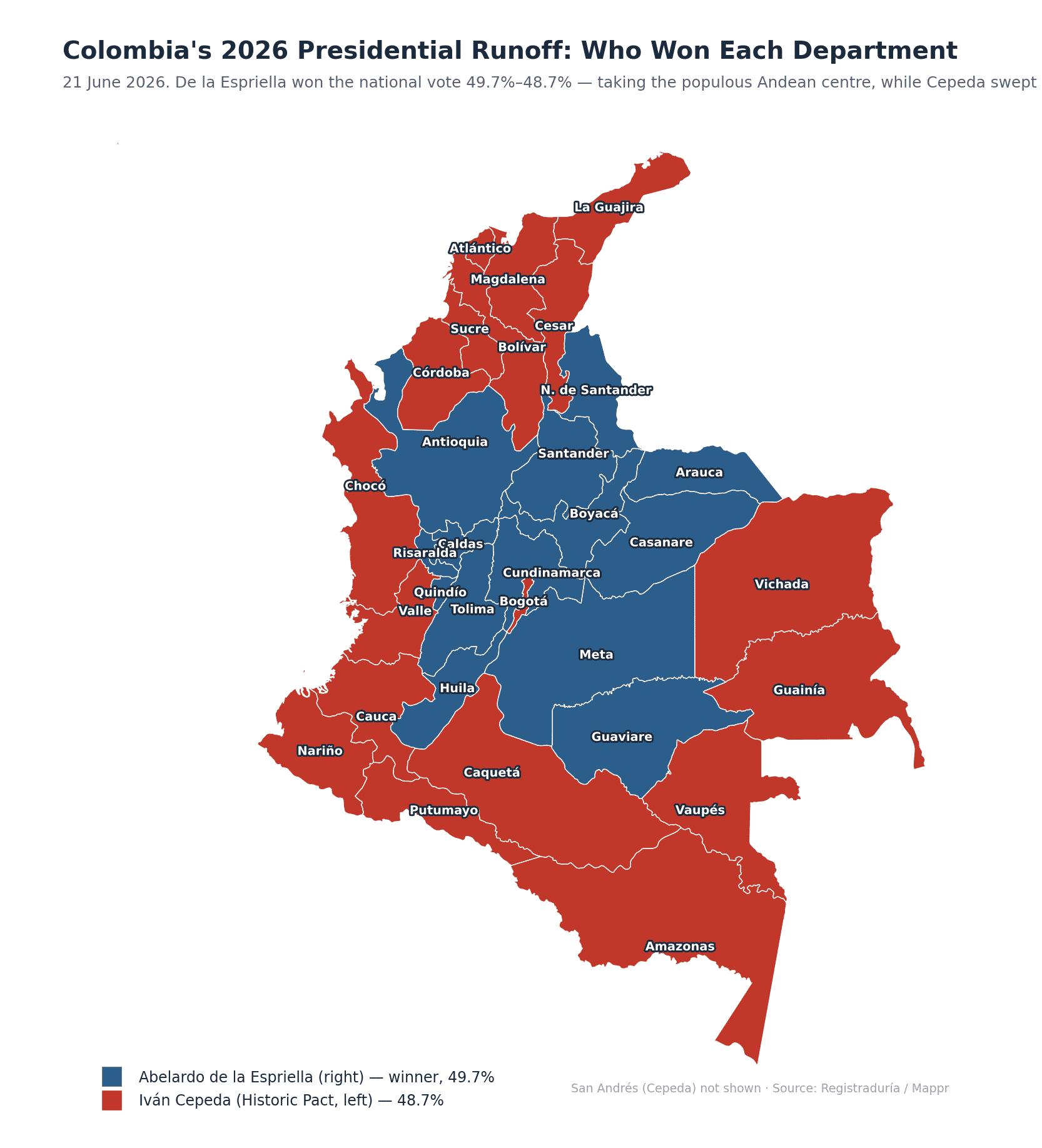
- A country split in two. De la Espriella won the populous Andean centre (Antioquia, Santander, Cundinamarca); Cepeda swept the Caribbean and Pacific coasts, the south, and Bogotá.
- Geography vs. population. Cepeda actually won more departments (19 to 14), but de la Espriella ran up huge margins in the big-population highland departments to take the national vote.
- Record turnout. Turnout hit about 63.6% — among the highest in Colombian history — and de la Espriella became the most-voted presidential candidate the country has ever had.
- Certified, Cepeda conceded. Colombia's electoral authority certified the count on 24 June 2026. After a brief legal challenge, Cepeda conceded, and de la Espriella is set to be inaugurated on 7 August 2026.
Colombia has elected a new president — narrowly. In the runoff on Sunday, 21 June 2026, right-wing lawyer Abelardo de la Espriella edged out the left’s Iván Cepeda by less than a percentage point, in one of the closest and highest-turnout elections in the country’s history. Here’s how the result broke down department by department.
Who won each department
Explore it yourself: hover any department
Hover (or tap) any department to see the winner and their vote share.
A country split down the middle
The map tells the story of two Colombias. De la Espriella dominated the Andean centre and the eastern plains — winning Antioquia (and Medellín) by a landslide, along with Santander, Norte de Santander, Cundinamarca, Boyacá, Tolima, Huila, the Coffee Region and the Llanos. Cepeda built his vote on the periphery: the Caribbean coast (Atlántico, Bolívar, Magdalena, Córdoba), the Pacific and south-west (Valle del Cauca, Cauca, Nariño, Chocó), much of the Amazon, and the capital, Bogotá.
Strikingly, Cepeda won more departments — 19 to 14 — yet lost the election. De la Espriella’s advantage came from where his votes were: the highland departments are far more populous, and he won them by wide margins (over 64% in Antioquia and Santander), outweighing Cepeda’s many wins in smaller, often conflict-affected regions.
The numbers
In the certified final count, de la Espriella took 49.7% (about 12.96 million votes, or 49.66% precisely) to Cepeda’s 48.7% (about 12.70 million), a gap of around 250,000 votes out of more than 26 million cast. Turnout reached about 63.6%, among the highest ever recorded in Colombia, and de la Espriella’s tally made him the most-voted presidential candidate in the country’s history. In the first round on 31 May, he had led with 43.7% to Cepeda’s 40.9% across a field of 13 candidates.
What it means
The result swings Colombia sharply to the right, ending the term of outgoing leftist president Gustavo Petro, whose movement Cepeda represented. De la Espriella, a combative lawyer who campaigned on security and a hard line on crime and ran with open support from allies of Donald Trump, will inherit a polarised country and a result so close that Cepeda initially asked for the final, official count and mounted a brief legal challenge before conceding. The electoral authority certified the result on 24 June 2026, and de la Espriella is set to be inaugurated on 7 August 2026.