
Key Takeaways
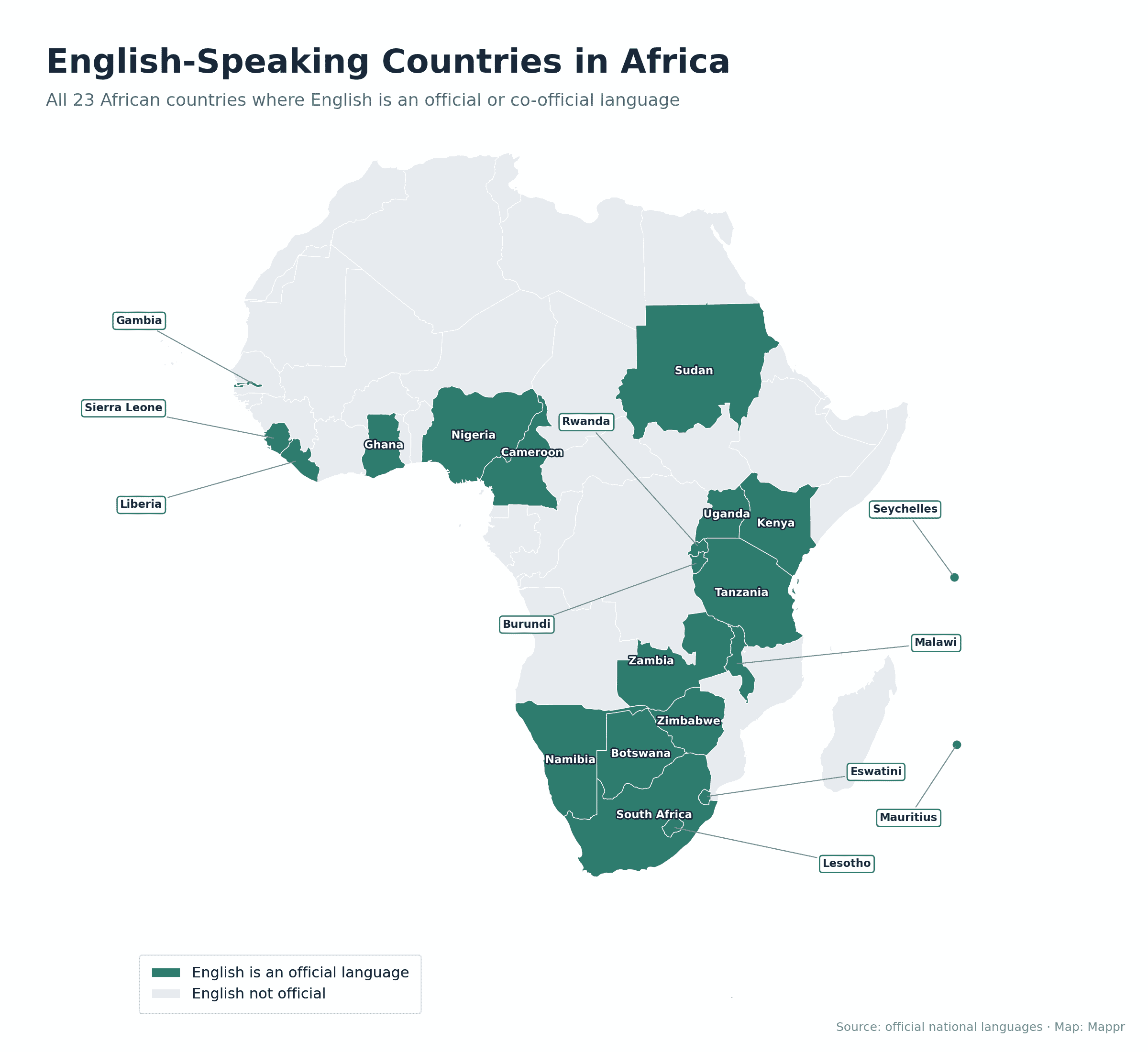
- 23 countries, English official. English is an official or co-official language in 23 African countries, a legacy of British colonial rule and mission schooling that persists across the continent.
- South Africa and Zimbabwe lead. On the EF English Proficiency Index 2025, South Africa and Zimbabwe tie as Africa's most proficient, both scoring 602 and ranking 13th in the world.
- Kenya, Zambia, Nigeria strong. Kenya (593), Zambia (573) and Nigeria (568) all rank in the global top 30 for English proficiency among adults.
- Often a lingua franca. In most of these countries English is a second language used in government, business, tourism and education rather than a mother tongue.
- The language of the African Union. English is one of the African Union's official working languages, alongside French, Arabic, Portuguese, Spanish and Swahili.
English is the most widely spoken language in the world, and across Africa it serves as a crucial bridge between hundreds of local languages. In 23 African countries English is an official or co-official language, mostly as a legacy of British colonial rule and mission-school education. For most speakers it is a second language used in government, business, tourism and schooling rather than a mother tongue, but it remains the common thread that ties much of the continent together.
The map below shows every African country where English holds official status, from Nigeria and Ghana in the west to Kenya, Uganda and Tanzania in the east and South Africa, Zimbabwe and Zambia in the south.
Map of English-speaking countries in Africa
How proficient are they? EF EPI 2025
Having English as an official language does not always mean the population speaks it fluently. The clearest yardstick is the EF English Proficiency Index (EF EPI), which ranks adult English skills worldwide. In the 2025 edition, South Africa and Zimbabwe top Africa, both scoring 602 and tying for 13th place globally, in the “high proficiency” band. Kenya (593), Zambia (573) and Nigeria (568) follow, all inside the world top 30.
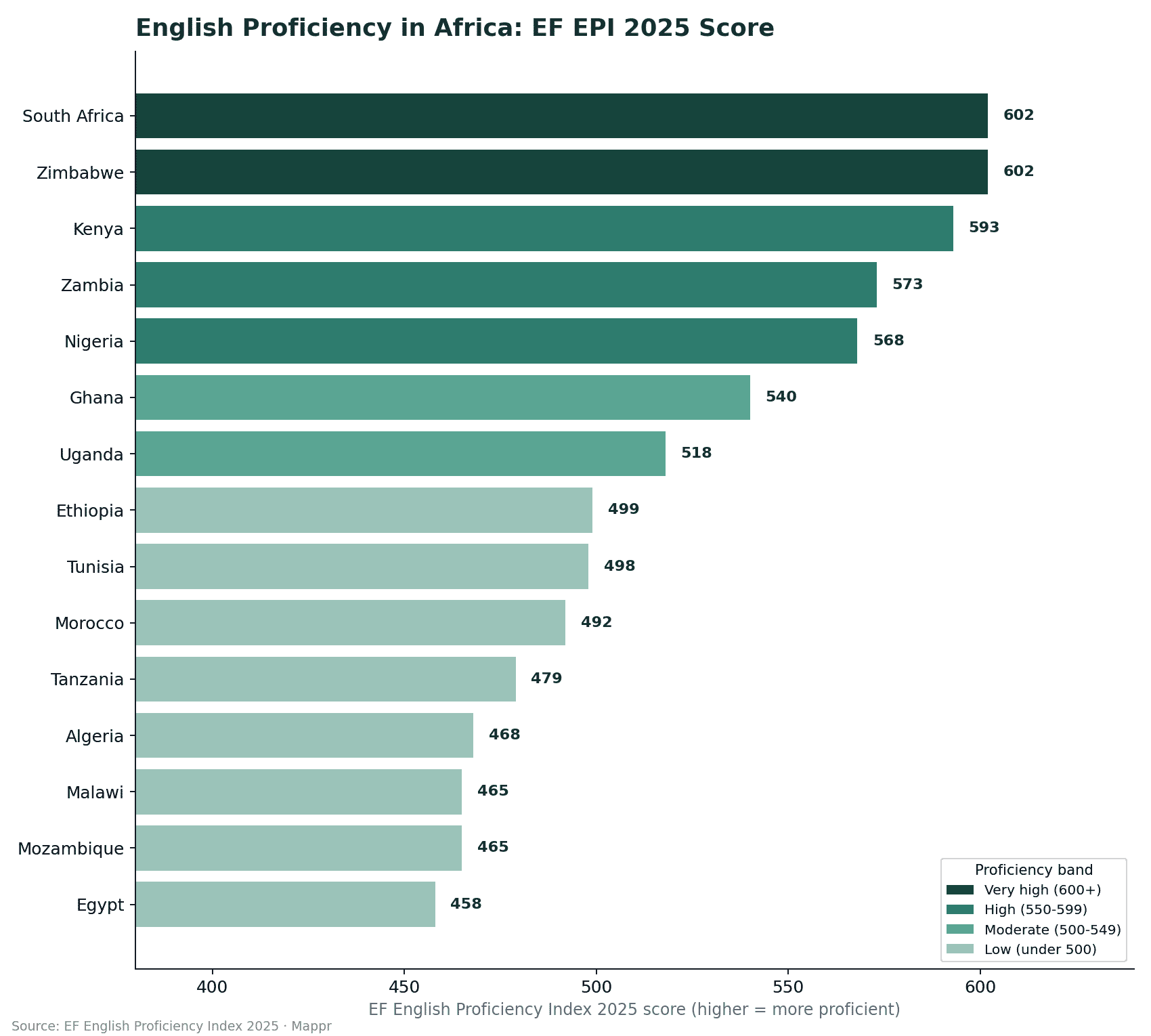
Several countries posted notable gains in 2025: Malawi jumped 18 points, Morocco rose 13 and Kenya climbed 12. Not every English-official country is measured by EF (the index needs enough test-takers), so smaller nations like Botswana, Namibia and the island states do not appear in the ranking even though English is official there.
The full list of English-speaking countries in Africa
Here are all 23 African countries where English is an official or co-official language, with their EF EPI 2025 proficiency score where available. The table is sortable and searchable.
| Country | English status | EF EPI 2025 score | Global rank |
|---|---|---|---|
| South Africa | Official (one of 12) | 602 | 13 |
| Zimbabwe | Official (one of 16) | 602 | 13 |
| Kenya | Official (with Swahili) | 593 | 19 |
| Zambia | Official | 573 | 27 |
| Nigeria | Official | 568 | 29 |
| Ghana | Official | 540 | 36 |
| Uganda | Official (with Swahili) | 518 | 53 |
| Tanzania | Official (with Swahili) | 479 | 77 |
| Malawi | Official (with Chichewa) | 465 | 84 |
| Cameroon | Official (with French) | 445 | 98 |
| Sudan | Official (with Arabic) | 421 | 106 |
| Rwanda | Official (with Kinyarwanda, French, Swahili) | 417 | 107 |
| Botswana | Official | Not tested | — |
| Eswatini | Official (with Swazi) | Not tested | — |
| Gambia | Official | Not tested | — |
| Lesotho | Official (with Sesotho) | Not tested | — |
| Liberia | Official | Not tested | — |
| Mauritius | Official (de facto) | Not tested | — |
| Namibia | Official | Not tested | — |
| Seychelles | Official (with French, Creole) | Not tested | — |
| Sierra Leone | Official (de facto) | Not tested | — |
| South Sudan | Official | Not tested | — |
| Burundi | Official (with Kirundi, French) | Not tested | — |
West Africa
Nigeria is the continent’s English-speaking giant: with over 200 million people and English as its sole official language, it is home to more English speakers than any other African country. Neighbouring Ghana, Sierra Leone, Liberia and the Gambia all use English officially, while Cameroon is officially bilingual in English and French. Many West Africans also speak vibrant English-based creoles such as Nigerian Pidgin and Sierra Leone’s Krio.
East Africa
In Kenya, Uganda and Tanzania, English shares official status with Swahili and is the main language of higher education, courts and business. Rwanda made a striking switch, adopting English as an official language and the medium of instruction in schools, despite its Francophone past. South Sudan, the world’s youngest country, chose English as its official language at independence in 2011.
Southern Africa
Southern Africa is the continent’s strongest English-speaking region. South Africa recognises English among its 12 official languages, and although only about 8% speak it as a first language, it dominates business and media. Zimbabwe, Zambia, Botswana, Namibia, Malawi, Lesotho and Eswatini all use English as an official language, a direct legacy of British colonial administration.
Why English is so widespread in Africa
The vast majority of English-speaking African nations inherited the language from decades of British colonial rule and from mission schools that educated young Africans in English. After independence, many kept English as a neutral official language that did not favour any single ethnic group, and as a gateway to global trade, universities and diplomacy. Today the internet, film and social media continue to spread English, and proficiency is climbing across much of the continent.
The bottom line
English is woven deeply into African life, holding official status in 23 countries and serving as a practical lingua franca in many more. Southern and East Africa lead the way on proficiency, with South Africa, Zimbabwe and Kenya among the most fluent on the continent, and the latest EF EPI 2025 data shows the trend is still pointing upward.
Data and references (latest available as of June 2026):


