Key Takeaways
- 3.4 billion people still lack a safely managed toilet. That is about 42% of the world. Safely managed sanitation, where waste is safely treated or disposed of, rose from 48% to 58% of the global population between 2015 and 2024.
- 354 million people have no toilet at all. Open defecation fell by 429 million people since 2015, but more than half of those still affected, 192 million, live in sub-Saharan Africa.
- In Niger, two in three people have no toilet. Niger (66%), South Sudan (63%) and Chad (62%) have the world's highest open defecation rates. India still has the most people affected, about 98 million, even after cutting its rate from 73% in 2000 to under 7%.
- It is now almost entirely a rural problem. Open defecation has fallen below 1% in cities worldwide but remains at about 9% in rural areas. Low-income countries are the only group not on track to end it by 2030.
Thursday 19 November is World Toilet Day, and this year’s UN theme is “Safe Toilets. Equal Futures.”, a reminder that the lack of a private, safe toilet falls hardest on women and girls, who face harassment, health risks and missed school days when there is nowhere safe to go.
The latest figures from the WHO/UNICEF Joint Monitoring Programme show real progress and a long way still to go. We mapped two measures for around 200 countries: where people still have no toilet at all, and where toilets are safely managed from the bowl to the treatment plant.
The Map: Where People Still Have No Toilet
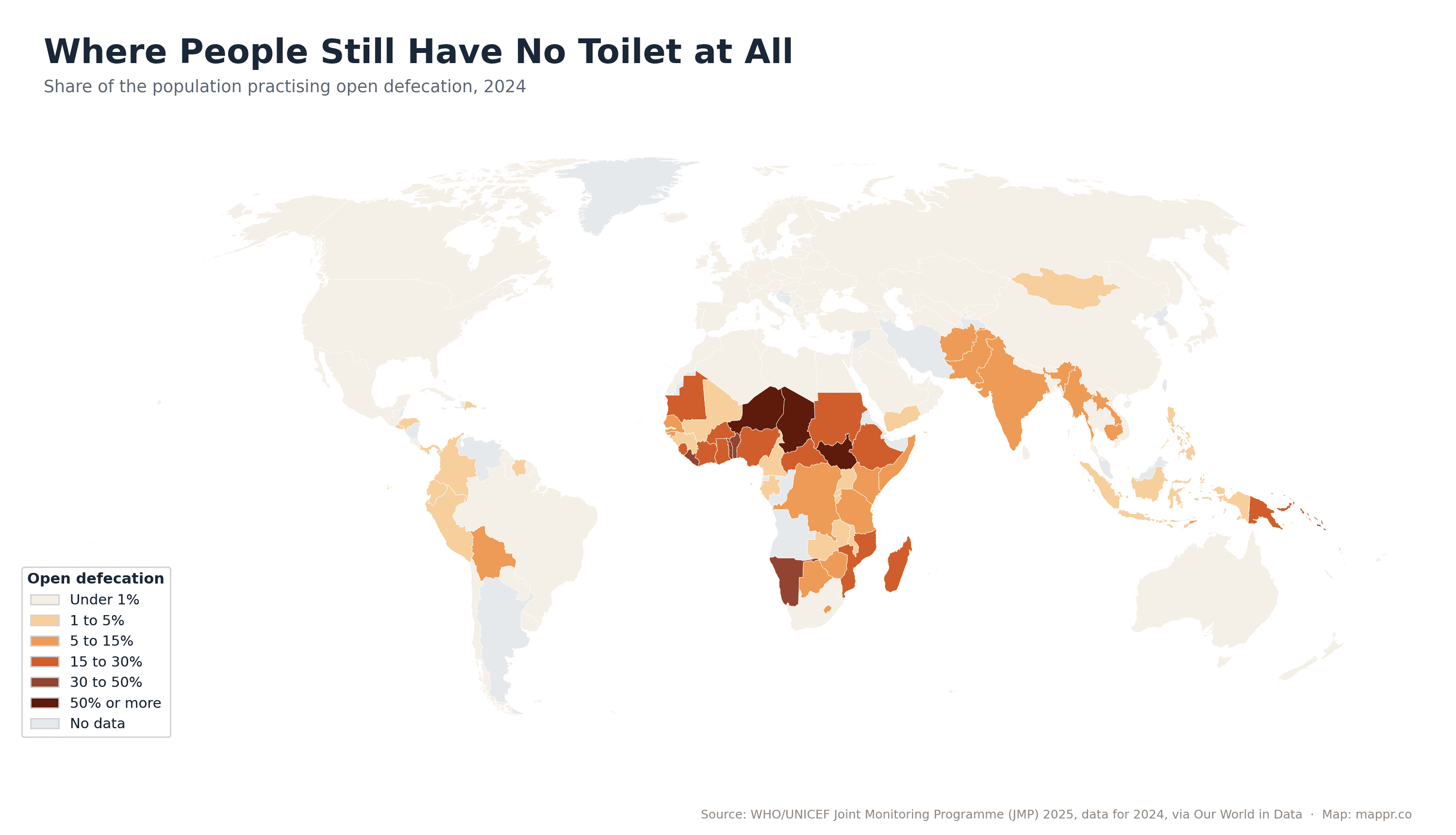
Open defecation means relieving yourself in fields, bushes, open water or other open spaces because there is no toilet or latrine of any kind. It is the starkest measure of sanitation poverty, and the map shows how concentrated it has become.
Across most of the world the rate is now below 1%. The dark band runs through the Sahel and West Africa, from Niger and Chad to Benin and Togo, plus South Sudan, Madagascar and Namibia. In South Asia, India and Pakistan sit in the middle bands, with low percentages but very large numbers of people.
The Highest Open Defecation Rates
Highest rates
15 Countries With the Highest Open Defecation Rates
Share of the population with no toilet at all, 2024
| Country | Open defecation | People affected | Has at least basic sanitation |
|---|---|---|---|
| 1. 🇳🇪 Niger | 66% | 17.8M | 16% |
| 2. 🇸🇸 South Sudan | 63% | 7.5M | 14% |
| 3. 🇹🇩 Chad | 62% | 12.6M | 13% |
| 4. 🇧🇯 Benin | 47% | 6.8M | 22% |
| 5. 🇸🇧 Solomon Islands | 45% | 371k | 35% |
| 6. 🇳🇦 Namibia | 35% | 1.1M | 39% |
| 7. 🇱🇷 Liberia | 34% | 1.9M | 23% |
| 8. 🇸🇹 São Tomé and Príncipe | 33% | 79k | 49% |
| 9. 🇰🇮 Kiribati | 32% | 44k | 45% |
| 10. 🇹🇬 Togo | 32% | 3.1M | 25% |
| 11. 🇧🇫 Burkina Faso | 30% | 7.0M | 32% |
| 12. 🇲🇬 Madagascar | 27% | 8.6M | 15% |
| 13. 🇨🇫 Central African Republic | 25% | 1.3M | 14% |
| 14. 🇳🇬 Nigeria | 18% | 41.8M | 48% |
| 15. 🇬🇭 Ghana | 18% | 6.1M | 32% |
In Niger, 66% of people have no toilet at all, and only 16% have even basic sanitation. Its rate has barely moved since 2015 (72%), and with one of the world’s fastest-growing populations, the number of people affected keeps rising.
The Pacific is a less familiar hotspot: in the Solomon Islands and Kiribati, a third or more of the population still practises open defecation.
Where the Most People Are Affected
Most people
Where the Most People Practise Open Defecation
Number of people with no toilet at all, 2024
| Country | People | Share of population | Share in 2015 |
|---|---|---|---|
| 1. 🇮🇳 India | 97.7M | 6.7% | 30.6% |
| 2. 🇳🇬 Nigeria | 41.8M | 18.0% | 20.5% |
| 3. 🇪🇹 Ethiopia | 21.4M | 16.2% | 36.5% |
| 4. 🇵🇰 Pakistan | 20.5M | 8.2% | 16.9% |
| 5. 🇳🇪 Niger | 17.8M | 66.0% | 72.1% |
| 6. 🇨🇩 DR Congo | 12.7M | 11.7% | 11.7% |
| 7. 🇹🇩 Chad | 12.6M | 62.2% | 65.6% |
| 8. 🇲🇬 Madagascar | 8.6M | 27.0% | 33.4% |
| 9. 🇸🇩 Sudan | 8.3M | 16.4% | 30.7% |
| 10. 🇸🇸 South Sudan | 7.5M | 62.8% | 68.3% |
Rates and headcounts tell different stories. India has an open defecation rate of just 6.7%, but that is still about 98 million people, more than a quarter of the global total. It is also the biggest success story: in 2000, 73% of Indians had no toilet. The government’s Swachh Bharat (Clean India) campaign, launched in 2014, built more than 100 million household toilets.
Nigeria is now second, with almost 42 million people affected, followed by Ethiopia and Pakistan. Other big improvers since 2015 include Cambodia (35% to 5%) and Nepal (25% to under 1%).
Safely Managed Sanitation: the SDG Target
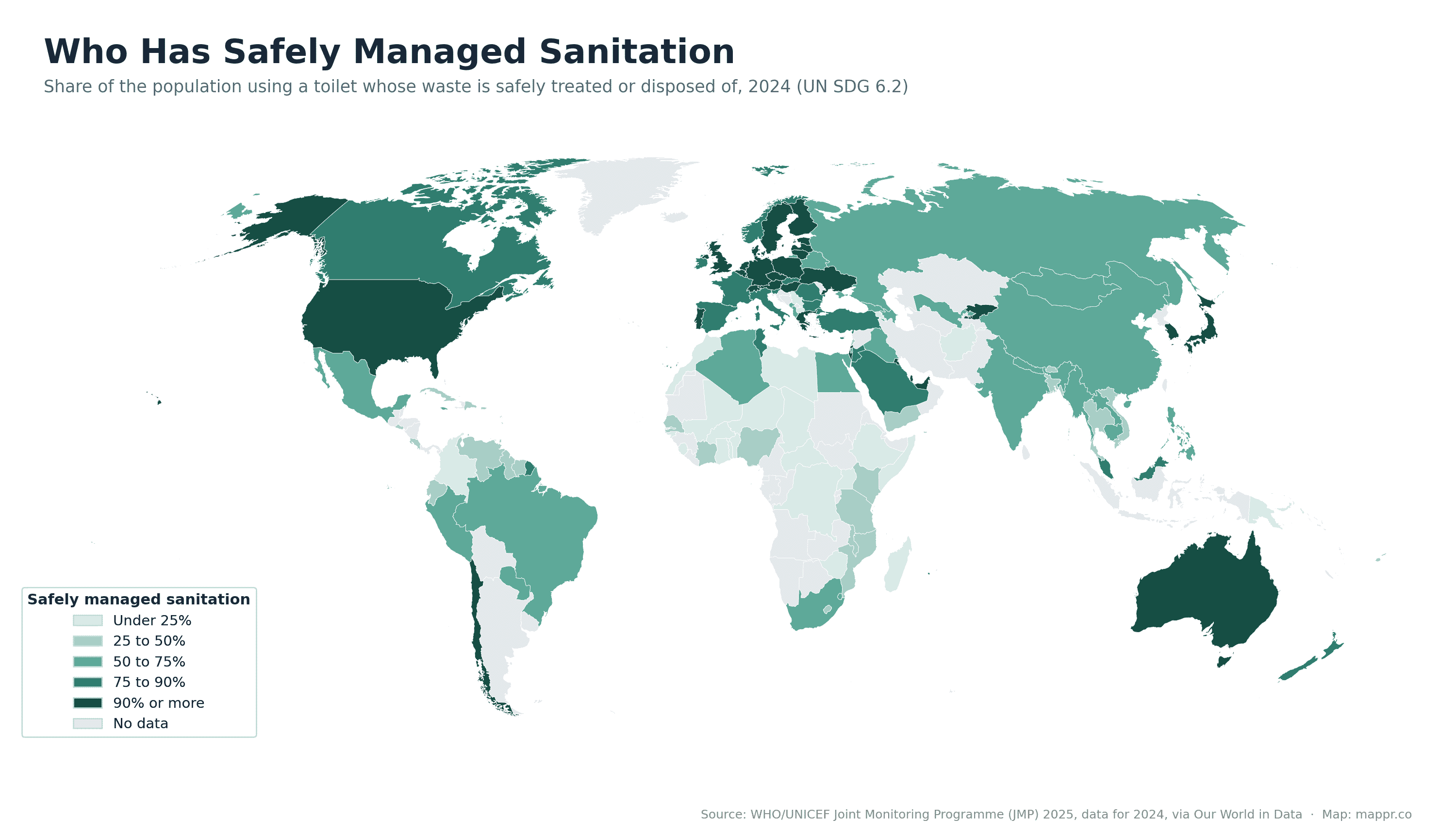
Having a toilet is not the end of the story. The UN’s Sustainable Development Goal 6.2 targets safely managed sanitation: a private toilet whose waste is safely treated, either through a sewer system that reaches a treatment plant or by emptying and safely disposing of septic tanks and latrine pits.
By that standard, 58% of the world was covered in 2024, up from 48% in 2015. That still leaves about 3.4 billion people without safely managed sanitation. Coverage tops 90% across most of Europe, North America, Australia and Japan, but is below 25% in much of sub-Saharan Africa, where data for many countries is missing altogether.
A Rural and Low-Income Problem
Open defecation has been almost eliminated in cities, where it is now below 1% of the urban population worldwide. In rural areas it is still about 9%, rising to almost a quarter of the rural population in sub-Saharan Africa and in low-income countries.
The world has committed to ending open defecation by 2030. At current rates, most regions will get there, but low-income countries are the only group not on track, with 16% of their people still practising open defecation today.
Why Toilets Are a Gender Issue
This year’s World Toilet Day theme puts the spotlight on women and girls. Without a safe toilet at home or school, they face a higher risk of harassment and violence when they have to go outside, often after dark, and many girls miss school during menstruation when there is nowhere private to manage it.
Poor sanitation is also a major public health issue: it spreads diarrhoeal diseases, cholera and parasitic worms, and contaminates water sources for entire communities. A safe toilet is one of the most cost-effective health interventions there is.
About the Data
All figures come from the WHO/UNICEF Joint Monitoring Programme for Water Supply, Sanitation and Hygiene (JMP), 2025 update, with data for 2024, accessed via Our World in Data. Open defecation figures cover about 200 countries; safely managed sanitation is estimated for 145, because many countries lack data on what happens to waste after it leaves the toilet.