
Key Takeaways
- UK net migration fell to 77,000. In the year to June 2026, 738,000 people arrived and 661,000 left. Net migration more than halved from 204,000 a year earlier and is the lowest since 1997, outside the pandemic.
- India and China send the most people. Indian nationals received 124,191 long-stay UK visas in the year to September 2026 and Chinese nationals 92,211, mostly for study. Nigeria, the United States and Pakistan follow.
- The fall is steepest for South Asia and Africa. Visas for Pakistani nationals fell 56%, Bangladeshi 44%, Nigerian 31% and Indian 25% in a year, after tighter rules on students' and care workers' dependants.
- More Britons and EU citizens are leaving than arriving. Net migration of British nationals was minus 137,000 and of EU nationals minus 45,000. Only non-EU migration, at plus 258,000, keeps the total positive.
In the year to March 2023, UK net migration reached 944,000, the highest level on record. On 26 November 2026, the Office for National Statistics reported that it has since fallen by more than nine-tenths: net migration was 77,000 in the year to June 2026, the lowest figure since 1997 outside the pandemic.
The headline number hides a simple question: who is still coming, and from where? Home Office visa statistics published the same day answer it country by country. We mapped them.
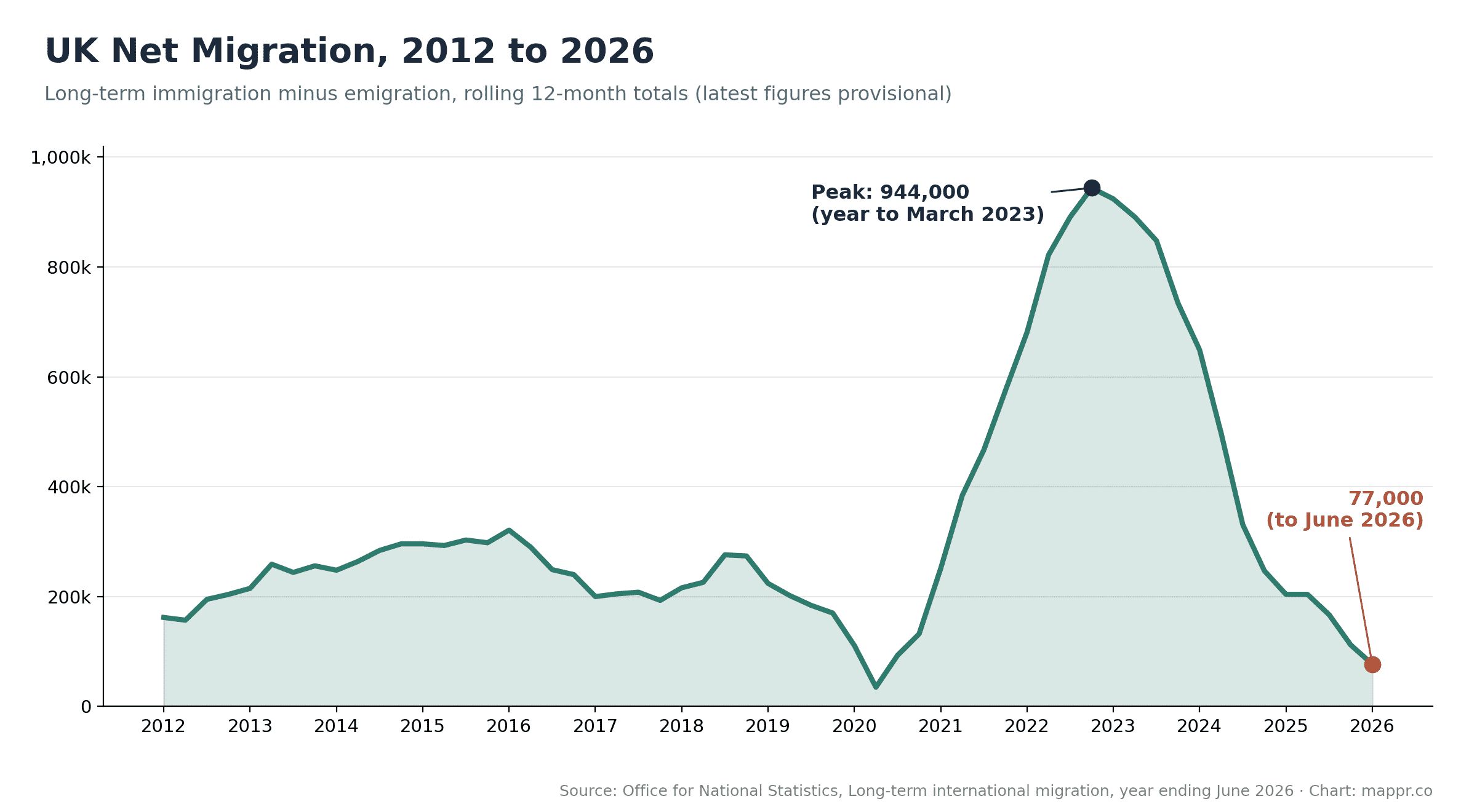
In the year to June 2026, 738,000 people moved to the UK, 17% fewer than a year earlier, while 661,000 left, about the same as before. The ONS stresses that the figures are provisional: it expects the final net migration number to fall somewhere between 31,000 and 128,000.
The Map: Who Is Coming to the UK?
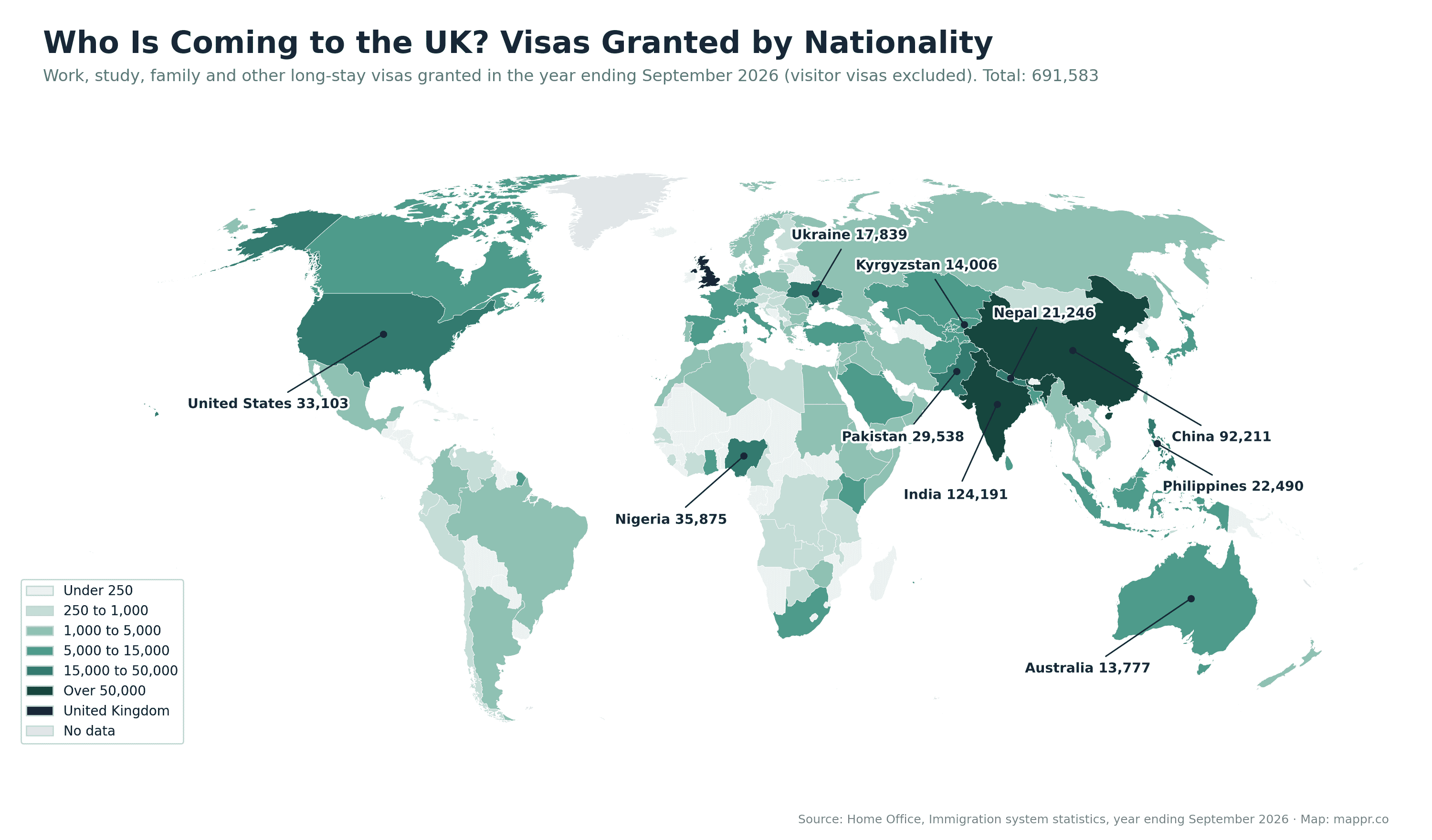
The UK granted 691,583 long-stay visas in the year to September 2026, covering work, study, family and humanitarian routes, 19% fewer than the year before. Two countries dominate: India (124,191) and China (92,211) account for almost a third of the total between them. In both cases most are students: 57% of Indian visas and 89% of Chinese visas were for study.
Nigeria (35,875), the United States (33,103) and Pakistan (29,538) complete the top five. Further down, the routes differ sharply by country. Most visas for the Philippines are for work, the majority of them for overseas domestic workers. Ukraine’s are almost all on humanitarian routes.
One surprise is Kyrgyzstan, ninth with 14,006 visas, nearly all of them seasonal worker visas. Together with Uzbekistan, Tajikistan and Kazakhstan, Central Asia supplied about four in five of the UK’s 41,484 seasonal farm workers.
Visas granted
Top 15 Nationalities Granted UK Long-Stay Visas
Year ending September 2026, visitor visas excluded
| Nationality | Visas granted | Change on year | Main route |
|---|---|---|---|
| India | 124,191 | -25% | Study |
| China | 92,211 | -11% | Study |
| Nigeria | 35,875 | -31% | Study |
| United States | 33,103 | +2% | Study |
| Pakistan | 29,538 | -56% | Study |
| Philippines | 22,490 | -15% | Work |
| Nepal | 21,246 | -24% | Study |
| Ukraine | 17,839 | +6% | Other, incl. humanitarian |
| Kyrgyzstan | 14,006 | +14% | Work |
| Australia | 13,777 | +5% | Work |
| Turkey | 10,979 | -11% | Study |
| Bangladesh | 10,567 | -44% | Study |
| France | 10,509 | +6% | Work |
| Canada | 9,972 | -1% | Work |
| Germany | 9,082 | +6% | Study |
Where the Fall Came From
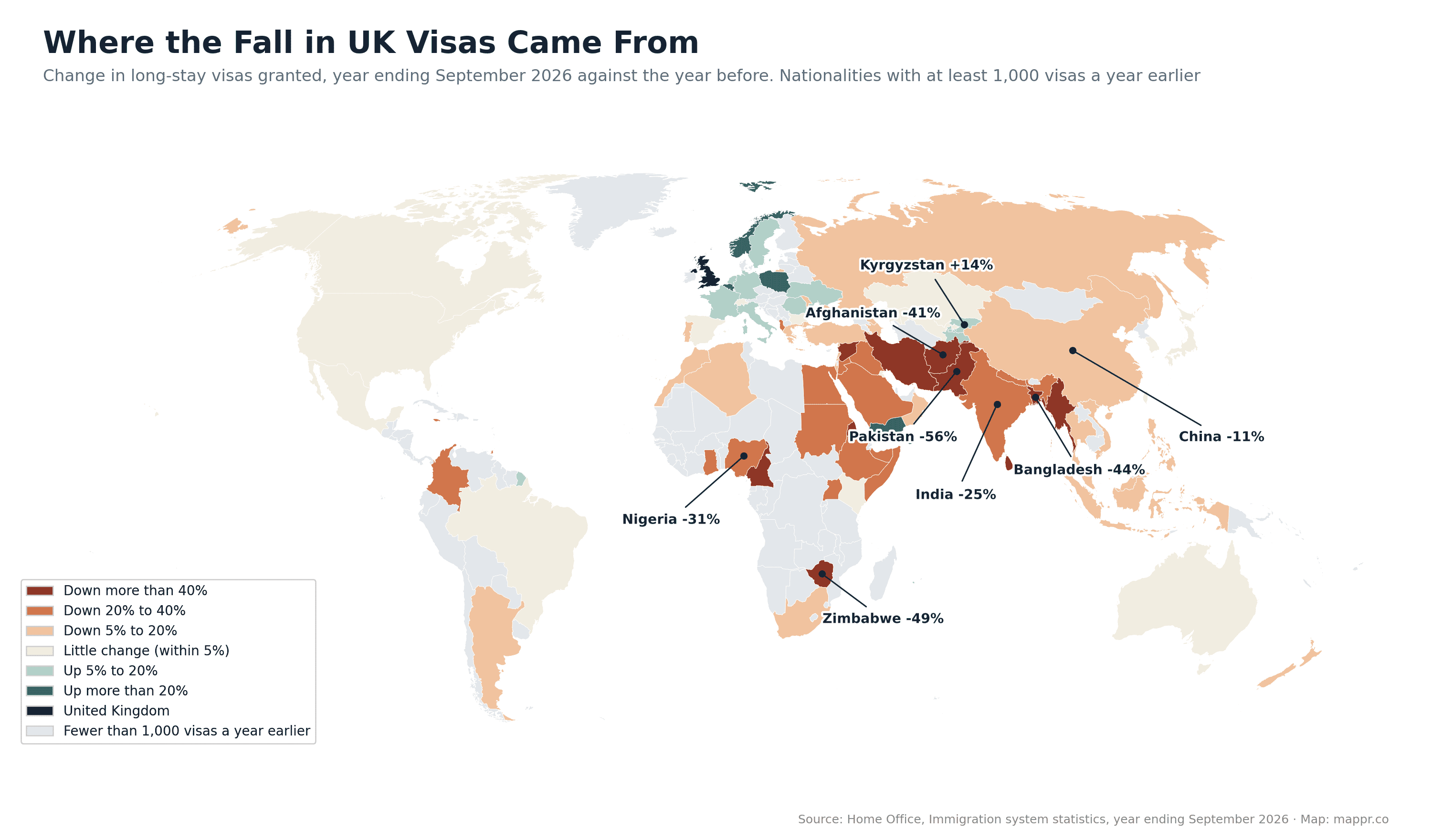
The drop is not spread evenly. Visas for Pakistani nationals fell 56% in a single year, Zimbabwean 49%, Bangladeshi 44%, Afghan 41%, Nigerian 31% and Indian 25%. These are the countries most affected by the rule changes made since 2024: most international students can no longer bring family members, care workers can no longer bring dependants, salary thresholds for skilled workers have risen and overseas recruitment of care workers has ended.
By contrast, visas for Americans, Australians, Canadians and most Europeans barely moved, and Central Asian seasonal-worker numbers rose. The ONS figures tell the same story by reason: among non-EU arrivals, work-related immigration fell 25%, study 11% and asylum from 93,000 to 73,000.
Who Is Leaving?
Arrivals and departures
Who Arrived and Who Left: Top Non-EU Nationalities
Long-term migrants, year ending June 2026 (provisional)
| Nationality | Arrived | Left | Net |
|---|---|---|---|
| India | 123,000 | 85,000 | +38,000 |
| China | 51,000 | 42,000 | +9,000 |
| Nigeria | 43,000 | 22,000 | +21,000 |
| Pakistan | 40,000 | 18,000 | +22,000 |
| United States | 21,000 | 9,000 | +12,000 |
| Ukraine | 16,000 | 16,000 | +0 |
| Bangladesh | 14,000 | 5,000 | +9,000 |
| Australia | 11,000 | 7,000 | +4,000 |
| Ghana | 9,000 | 5,000 | +4,000 |
Emigration matters as much as immigration. Many of the people who arrived during the 2022 and 2023 peak were students, and they are now finishing their courses and going home: the ONS estimates that about 53% of the non-EU nationals who left had originally come to study. Some 85,000 Indian nationals and 42,000 Chinese nationals left in the year to June 2026.
British and EU citizens are leaving too. About 245,000 British nationals emigrated and 109,000 returned, a net outflow of 137,000. For EU nationals, the net figure was minus 45,000, a continuation of the trend since Brexit. Only the net arrival of 258,000 non-EU nationals keeps the overall figure above zero.
Where the British emigrants go is harder to map. The ONS says it has no recent data on their destinations. What exists are counts of UK-born residents abroad, such as an estimated 1.1 million in Australia and about 295,000 in Spain, and those figures say little about who left this year. The ONS notes that about two-thirds of British emigrants are aged 16 to 34.
What It Means
Lower net migration was the stated aim of successive UK governments, and by that measure policy has worked. But the ONS also reported that the UK population grew by only about 80,000 in the year to mid-2026, the slowest growth since 1983, with births exceeding deaths by just 3,000. With an ageing population, universities that depend on international fees and a care sector short of staff, the debate is likely to shift from how to cut migration to how low it can go.
Sources: