
Nearly a third of American young adults aged 18 to 34 are still living at home with their parents — and in some states, the figure climbs to nearly half. According to the latest 2024 American Community Survey (ACS) data from the U.S. Census Bureau, 32.5% of young adults nationwide live in a parent’s home, up from 31.8% in 2023.
The trend is driven primarily by soaring housing costs, especially in high-rent coastal states. But cultural factors, demographic shifts, and the lingering economic effects of the pandemic also play a role. Here’s where the phenomenon is most — and least — pronounced.
Interactive Map: Young Adults Living at Home by State
Use the interactive map below to explore the share of 18-34 year-olds living with their parents in every U.S. state. Hover over a state to see its percentage. Darker shades of red indicate higher rates.
The States Where the Most Young Adults Live at Home
The gap between states is enormous. In New Jersey, nearly half of all 18-34 year-olds — an estimated 44% — live with a parent. Meanwhile, in North Dakota, that figure is just 12%.
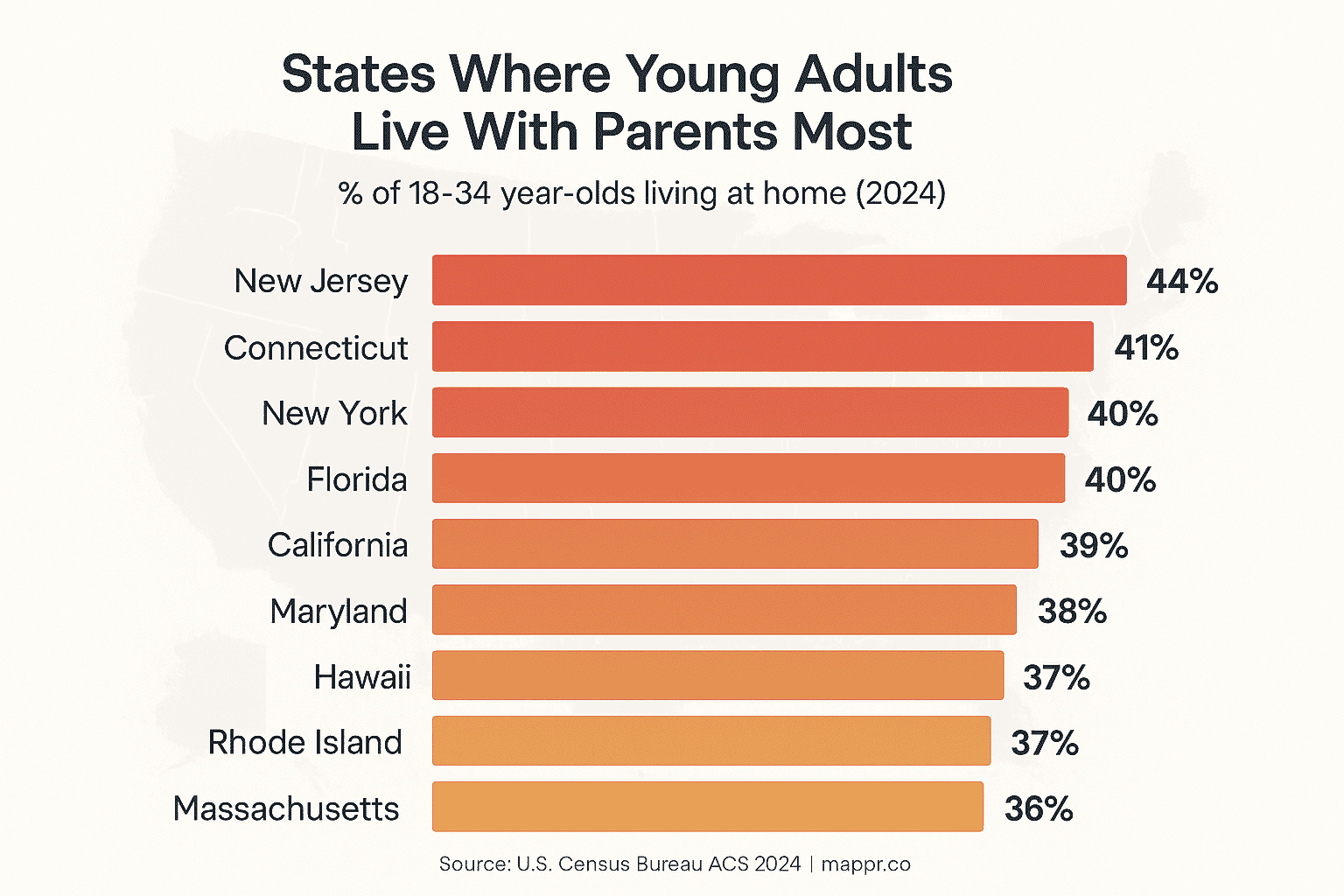
Top 10 States — Highest % of Young Adults at Home
- New Jersey — 44%
- Connecticut — 41%
- New York — 40%
- Florida — 40%
- California — 39%
- Maryland — 38%
- Hawaii — 37%
- Rhode Island — 37%
- Massachusetts — 36%
- Delaware — 36%
Bottom 5 States — Lowest % of Young Adults at Home
- North Dakota — 12%
- District of Columbia — 13%
- South Dakota — 18%
- Wyoming — 18%
- Montana — 19%
Why Are So Many Young Adults Living at Home?
The reasons behind this trend are layered, but housing affordability stands out as the dominant factor.
🔑 Key Takeaways
- 32.5% of Americans aged 18-34 live with their parents (2024), up from 31.8% in 2023
- The historic peak was 34.5% in 2017, before a brief post-pandemic dip
- Housing costs are the #1 driver — states with the most rent-burdened populations have the highest rates
- Young men are more likely to live at home than young women (20% vs. 15% for ages 25-34)
- Racial and ethnic differences are significant — white young adults are less likely to live at home than Asian, Hispanic, and Black peers
- The trend has been rising since 2000, when only 12% of 25-34 year-olds lived with parents
The Housing Affordability Connection
Statistical analysis from the National Association of Home Builders (NAHB) confirms a clear correlation: states where renters are most cost-burdened — paying 30% or more of income on housing — consistently show higher rates of young adults living at home.
This explains why high-cost coastal states dominate the top of the list. New Jersey, Connecticut, New York, California, and Massachusetts all have some of the nation’s most expensive rental markets. Many young adults in these states find it more practical to commute from a parent’s home than to spend the majority of their income on rent.
Conversely, states in the Great Plains and Mountain West — North Dakota, South Dakota, Wyoming, Montana — have significantly lower housing costs and far fewer young adults living at home.
A Generational Shift, Not Just an Economic One
While economics drives much of the trend, cultural attitudes are shifting too. As LendingTree analyst Matthew Schulz notes: “There’s much less stigma about being older and living with your parents today. People are more practical.”
Many young adults report that living at home is good for their finances — allowing them to save for down payments, pay off student debt, or build emergency funds. The annual savings can be substantial: a Federal Reserve report estimates that living at home saves young adults roughly $13,000 per year.
However, young adults are less enthusiastic about the arrangement’s impact on their social lives. The trade-off between financial stability and independence remains a defining tension for this generation.
Metro-Level Data Tells an Even Starker Story
While state-level data reveals broad patterns, metro-area data from the Pew Research Center paints an even more dramatic picture. Among 25-34 year-olds specifically:
- Vallejo, California — 33% live with parents
- Oxnard-Thousand Oaks, California — 33%
- El Centro, California — 32%
- Riverside, California — 22% of working adults 25-40
At the other extreme, metros like Odessa, Texas and Lincoln, Nebraska see rates as low as 3%. Nine of the ten metros with the highest rates are in California, Texas, or Florida.
Looking Ahead
With housing costs continuing to rise and wage growth lagging behind, there’s little indication this trend will reverse soon. The 2024 data already shows a reversal of the post-pandemic dip, and economists expect the share of young adults at home to remain elevated throughout the decade.
For the housing market, the implications are significant. Millions of potential renters and first-time homebuyers are effectively sidelined — living in their childhood bedrooms instead of driving demand in the housing market. When they do eventually move out, the pent-up demand could reshape housing markets across the country.


Sources and data used in this article:
Data Sources:
- U.S. Census Bureau — American Community Survey (ACS) 2024 – Primary data source for state-level young adult household composition
- NAHB Eye on Housing — Affordability Impacts: Young Adults Moving Back Home – Housing affordability analysis and state-level correlation data
Research & Analysis:
- Pew Research Center — Young Adults Living With Parents Across the U.S. – Metro-area analysis of 25-34 year-olds living with parents
- Visual Capitalist — Where Young Adults Live With Their Parents – State-level visualization and national trend data
- CNBC — Where Young Adults Are Most Likely to Live With Parents – Analysis of LendingTree and Federal Reserve data
Featured image generated with AI. Map and infographic: mappr.co