Hungary just had its most consequential election in decades — and the result is a political earthquake. Péter Magyar’s centre-right TISZA party swept to a landslide victory on April 12, 2026, ending Viktor Orbán’s 16-year grip on power and securing a two-thirds supermajority in parliament.
With 97% of precincts counted, TISZA took 53.4% of the vote and 138 of 199 seats. Orbán’s Fidesz–KDNP alliance collapsed to 38% and just 55 seats — a loss of 80 seats from its previous 135. The far-right Mi Hazánk scraped through with 5.9% and 6 seats. Turnout hit a post-Communist record of nearly 79%.
The implications ripple far beyond Budapest. Orbán was Russia’s closest ally in the EU, a persistent NATO skeptic, and the single biggest obstacle to European unity on Ukraine. His defeat reshapes the geopolitical map of Europe.
The Results Map
TISZA didn’t just win — it dominated everywhere. The party swept roughly 94 of Hungary’s 106 single-member constituencies, winning not only Budapest and major cities like Debrecen, Szeged, and Pécs, but flipping traditional Fidesz strongholds across western and central Hungary. Fidesz held only a handful of rural constituencies in the far east, primarily in Szabolcs-Szatmár-Bereg, Borsod-Abaúj-Zemplén, and Békés counties.
Click markers on the map to see estimated vote shares by county. Blue = TISZA, orange = Fidesz–KDNP.
Election Results at a Glance
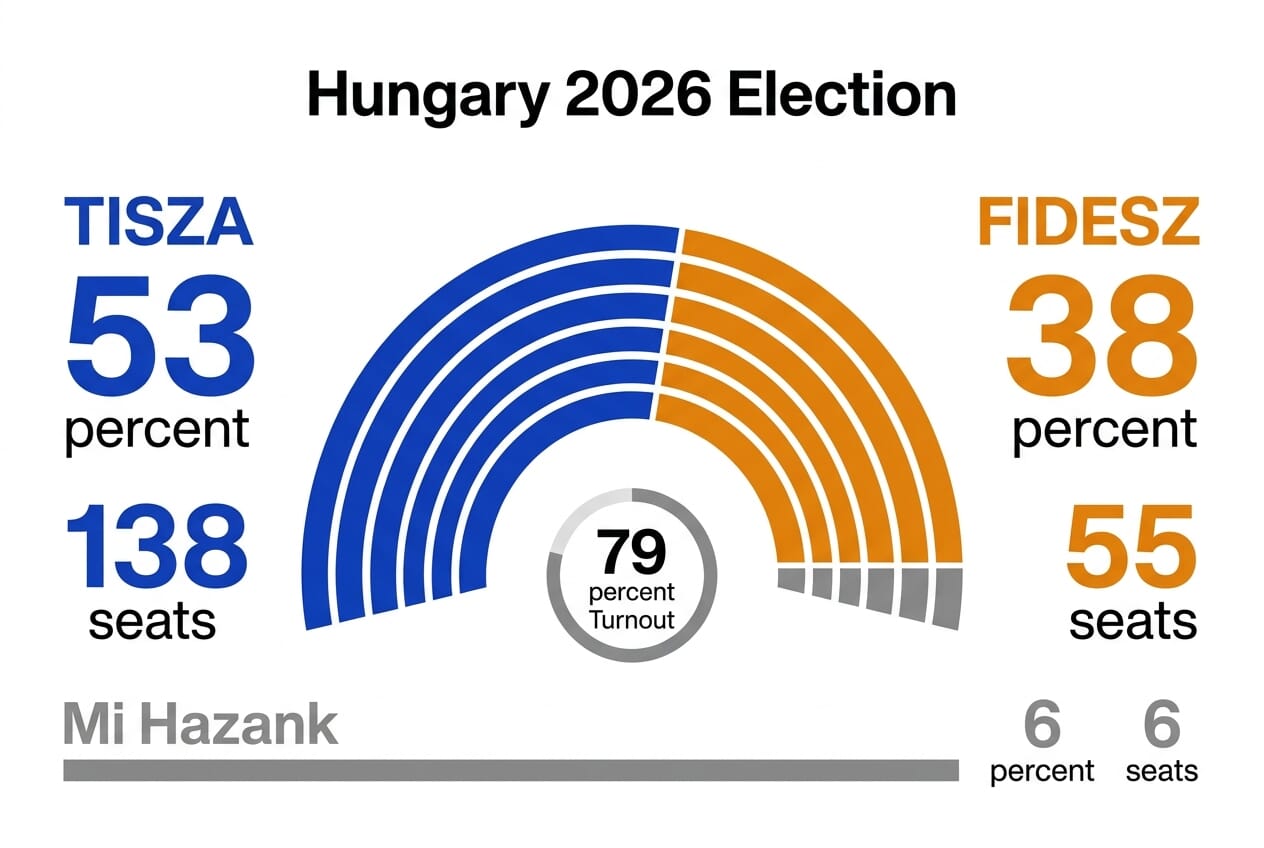
Hungary’s electoral system — a mix of 106 single-member constituencies and 93 proportional seats — heavily amplified TISZA’s margin. The party’s 53.4% vote share translated into 69% of all seats, enough for the two-thirds supermajority needed to amend the constitution.
Who Is Péter Magyar?
Magyar is a former Orbán insider who broke with the regime in early 2024, publicly accusing the government of corruption and institutional capture. He founded TISZA (Tisztelet és Szabadság Párt — Respect and Freedom Party) and built a mass movement that consolidated virtually the entire opposition behind a single banner. The Hungarian Socialist Party, Momentum, and other opposition parties withdrew before the election, clearing the path for a two-way race.
“Tonight, truth prevailed over lies,” Magyar told supporters. “This many people have never voted before, and no single party has ever received such a strong mandate.”
Orbán conceded on election night: “The responsibility and possibility of governing was not given to us. We are going to serve the Hungarian nation from opposition as well.”
What This Means for the EU
For Brussels, this is the biggest relief in years. Orbán had spent over a decade vetoing EU decisions, blocking sanctions, stalling Ukraine aid, and undermining rule-of-law mechanisms. Hungary under Fidesz was the EU’s most disruptive member state.
Magyar’s TISZA has pledged to “choose Europe” — rebuilding trust with EU institutions and committing to eurozone membership by 2030. European Commission President Ursula von der Leyen said “Europe’s heart is beating stronger in Hungary tonight.” French President Emmanuel Macron called it “a victory which shows the attachment of the Hungarian people to the values of the European Union.”
With a constitutional supermajority, Magyar can dismantle the institutional architecture Orbán built to entrench Fidesz control — packed courts, captured media regulators, state-owned enterprises staffed with loyalists, and a gerrymandered electoral map.
What This Means for NATO and Ukraine
Orbán’s defeat removes NATO’s most vocal internal skeptic. Hungary under Fidesz blocked or delayed alliance decisions, maintained warm ties with Moscow, and refused to allow weapons transits to Ukraine across Hungarian territory.
The most immediate impact: a €90 billion EU loan to Ukraine that Budapest had been blocking. Orbán had demanded the resumption of Russian oil deliveries via the Druzhba pipeline as a condition for dropping his veto. That leverage is now gone.
Magyar has vowed to end what he calls the “betrayal” of Hungarian and European interests through collusion with Russia, positioning Hungary as a constructive NATO ally. Ukrainian President Volodymyr Zelenskyy was among the first world leaders to congratulate Magyar on his victory.
What This Means for Russia
Moscow just lost its most important foothold inside the European Union. Orbán’s Hungary was the Kremlin’s reliable veto — blocking sanctions rounds, slowing EU accession talks for Ukraine, and providing diplomatic cover for Russia’s position in European forums.
The defeat also carries symbolic weight. Orbán was a flagship for the model of “illiberal democracy” that Putin championed as an alternative to Western liberal governance. His fall after 16 years undermines the narrative that authoritarian-leaning leaders are electorally invincible once entrenched.
JD Vance’s last-minute campaign rally with Orbán — an unusual move for a sitting US Vice President to intervene in a foreign election — backfired spectacularly. The Trump administration’s bet on Orbán as a European anchor now leaves Washington scrambling to build ties with a new Hungarian government that may be less aligned with American populist politics.
Key Takeaways
- Landslide victory: TISZA won 138 of 199 seats (53.4%) — a two-thirds supermajority that allows constitutional changes
- Record turnout: Nearly 79% of voters participated, the highest in Hungary’s post-Communist history
- End of an era: Orbán’s 16-year rule ends — the longest-serving government in modern Hungarian history
- EU realignment: Hungary pivots from EU’s most disruptive member to a committed European partner, with eurozone entry targeted by 2030
- Ukraine boost: The €90 billion EU loan to Kyiv that Orbán blocked is now expected to proceed
- Russia loses ground: Moscow’s most reliable EU ally is gone, weakening the Kremlin’s ability to divide European consensus
- Constitutional reset: Magyar can now undo Fidesz’s institutional capture — courts, media, state enterprises
Featured image: Raquel García / Unsplash
Sources and references for this article.
News Coverage
- Al Jazeera — Peter Magyar's Tisza wins Hungary election – Election night results and reaction coverage
- CNN — Live updates: Orbán concedes defeat after 16 years – Live coverage of election results and concession
- France 24 — Hungarian election-winner Magyar says country liberated – Magyar victory speech and international reaction
- NBC News — Orbán concedes defeat as Tisza Party heads for win – Detailed results and geopolitical analysis
Analysis
- Atlantic Council — Hungarian election implications for EU, US, Russia, Ukraine – Geopolitical implications analysis
- Euronews — Peter Magyar and EU hope for new beginning – Magyar policy platform and EU relations outlook
Official Data
- Hungarian National Election Office — Official Results – Official vote tallies and constituency results
- Wikipedia — 2026 Hungarian parliamentary election – Comprehensive election overview with seat allocation data
Image Sources
- Raquel García / Unsplash — Featured image – Hungarian Parliament building photograph